General Illumination
Jackson’s chameleons are diurnal, which means that they are most active during the day, like humans. This also means that they need a source of bright light in the enclosure during the day — and they like a LOT of light. I recommend installing either two T5 HO 6500K fluorescent grow lamps, or a single high-PAR LED grow lamp to meet your chameleon’s visible light needs.
Here are my picks for daytime chameleon illumination:
If you have live plants in your setup, I recommend using LEDs over fluorescents for best growth.
Why full-spectrum?
Bulbs that produce full-spectrum light are thought to stimulate more natural behaviors and promote mental health in animals. Personally I think we humans need to be using them ourselves in our indoor environments — have you ever noticed how much lovelier things look in sunlight? Full-spectrum bulbs also promote optimum plant health if you plan on having live plants in your enclosure (which is strongly recommended with this species).
Chameleons see color particularly well, so full-spectrum lighting is a must-have for this pet.
What is UVB, and why do chameleons need it?
There are 3 types of ultraviolet radiation produced by the sun: UVA, UVB, and UVC. Most animals require regular exposure to UVA and UVB in order to produce vitamin D3, see properly, and, to keep it brief, thrive in general. Even humans need UVA and UVB for vitamin D3 synthesis and mental health, although since we don’t have scales to protect us, staying out in UVB for too long will give us a sunburn.
Vitamin D3 is important because it helps animals metabolize calcium for muscle, bone, and nervous system health. When they don’t get enough D3, they because deficient, which leads to Metabolic Bone Disease.
Since Jackson’s chameleons are diurnal, UVB lighting is required for them to stay alive in captivity. This is not an optional part of their setup! Use a T5 HO (high-output) fluorescent UVB bulb to help the rays get all the way to the bottom of the enclosure and create a more effective UV gradient.
How to set up UVB for your Jackson’s chameleon
Jackson’s chameleons are classified under Ferguson Zone 2-3, and according to leading chameleon breeder/educator Bill Strand, they should receive a UVI of 3.0-4.0 in the basking area. This should be the area of highest temperature and UV in the enclosure. (T. j. merumontanus should have a basking UVI no lower than 4.0.)
The strength of UVB that a reptile is exposed decreases in proportion to increased distance from the bulb, so it’s very important to take distance into consideration when you’re installing the basking area. Specifically, you need to pay attention to the distance between the UVB bulb and the chameleon’s back when it’s on the basking surface:
Lamp mounted above mesh (recommended for safety):
Without mesh obstruction:
You will need to mount your UVB bulb in a Vivarium Electronics T5 HO or Arcadia ProT5 fixture. Optimal use distance is likely to be more variable if you use something different.
The above distance recommendations assume a ~30% mesh block. It is strongly recommended to use a Solarmeter 6.5 to determine the best placement. For more details on adjusting basking distance based on mesh obstruction, see the Facebook group Reptile Lighting > Guides > Guide 1: Using T5-HO lamps above a Mesh Screen.
If you need more distance between your snake and the UVB in the basking area than your enclosure’s setup will allow, I recommend using a UVB Riser to strategically increase the distance for your snake’s safety. (Here’s a product review I did for one by Custom Reptile Habitats in 2022!)
PRO TIPS:
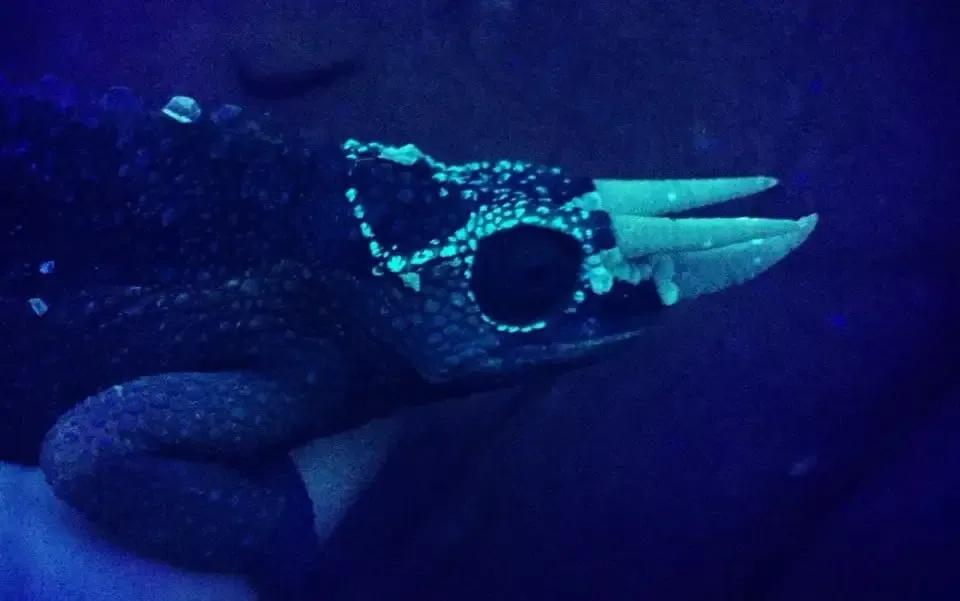
Male demonstrating fluorescence under UV light. Contributed by Stacey Vandenhoudt.