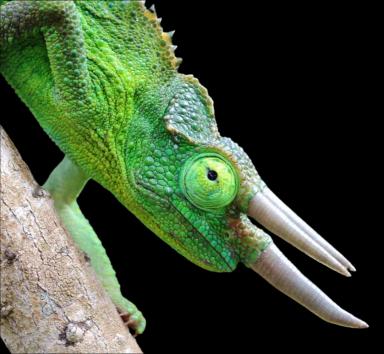

The Jackson’s chameleon is a diurnal arboreal lizard native to Kenya and Tanzania. There is also a significant invasive population on the Hawaiian islands. They prefer cool, humid mountain slopes with plenty of rain and vegetation. They have also been observed to thrive alongside humans in hedges, small trees, gardens, and plantations.
They are a medium-sized chameleon, ranging between 7-14” (17-35cm) in length, depending on subspecies, with males being larger. The Jackson’s chameleon is generally recognized as a bright green lizard with darker patterning, which changes based on mood, temperature, and intent — not camouflage. Males are distinguished by three forward facing horns, not unlike a Triceratops dinosaur.
Chameleons are relatively short-lived, as reptiles go. Male Jackson’s chameleons can be reasonably expected to live up to 9 years, while females only live up to 5-6 years. This makes them longer-lived than most other chameleon species.
There are 3 known subspecies of Trioceros jacksonii:
All three are listed as species of Least Concern on the IUCN Red List due to widespread natural occurrence and tolerance of habitat modification. However, CITES lists all chameleons as Threatened due to habitat destruction and collection for the pet trade.
There is a common misconception that chameleons are difficult to keep in captivity, but thanks to captive breeding efforts and modern husbandry research, captive-bred Jackson’s chameleons sourced from quality breeders are actually fairly hardy with consistent care and a proper enclosure. That being said, Jackson’s chameleons are still more difficult to keep than Panther or Veiled chameleons, and according to Chameleons and Vitamin A, “there is ample evidence to illustrate that chameleons are far better suited to life in the wild and should not be considered a domesticated animal.”
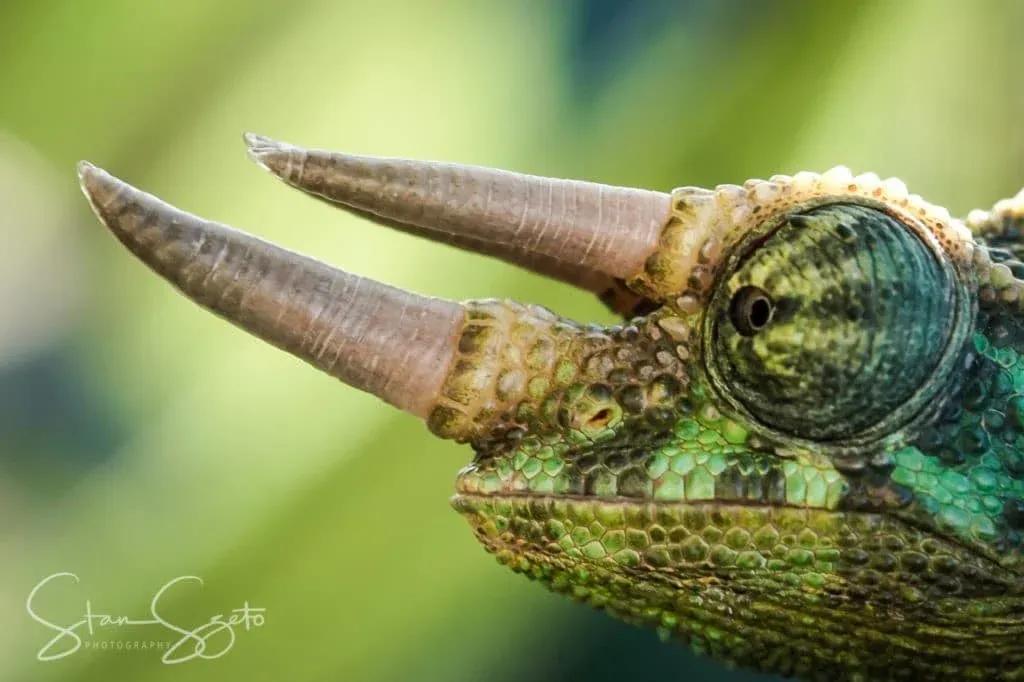
Contributed by Stan Szeto