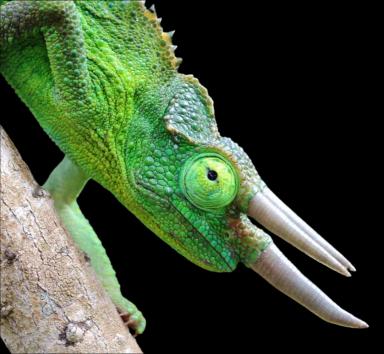
Data from wild Jackson’s chameleons in Hawaii (T. j. xantholophus) shows that they prefer areas with daytime temperatures between 61-81°F (16-27°C) and nighttime temps between 39-64°F (4-18°C). (Preliminary Study of the Behavior and Ecology of Jackson’s Chameleon of Maui, Hawaii) However, this data can only be applied to wild-caught T. j. xantholophus and their descendants, and should not be applied to the other two subspecies.
As pets, Jackson’s chameleon keepers have noticed that they get the best results with the following temperature gradient:
Temperatures are sourced from Dr. Frances Baines’ UV Tool, adjusted according to observations from Bill Strand and Petr Necas.
Note that T. j. merumontanus prefers cooler temperatures than the other two, with a basking temperature around 79°F (26°C), shade temperatures of 64-68°F (18-22°C), and a nighttime drop preferably under 59°F (15°C).
A temperature gradient describes the variation in temperature within a given area. Providing a range of temperatures within your enclosure more closely mimics nature than keeping the entire area the same. This is especially important since reptiles are cold-blooded, and rely on variations in the temperature of their environment to get warmer or cooler as needed.
Measure your temperature gradient with a combination of an infrared thermometer (temp gun) and a digital thermometer. The temp gun measures surface temperatures, which is very important for making sure that your basking surface isn’t too hot or cool. The digital thermometer measures air temperatures, which are going to be naturally lower than the basking surface temperature since surfaces exposed to heat will absorb heat, while air diffuses heat instead. I use the Etekcity 774 temp gun and Zoo Med Digital Thermometer + Hygrometer to keep track of these two measurements.
Jackson’s chameleons typically bask twice per day, typically in the early morning and later afternoon for no more than 30 minutes each.
In order to create a basking spot (and at the same time, your temperature gradient), all you need is a heat lamp. I recommend a dimmable ceramic-socket dome lamp with a white light halogen or incandescent heat bulb. The heat lamp should be placed on top of the enclosure, never inside. Some keepers prefer to hang the dome lamp from a lamp holder like this one designed by Zoo Med.
My preferred heat bulbs for Jackson’s chameleons:
Optimal wattage will vary depending on the distance between your chameleon and the heat lamp, as well as your room temperature. Higher wattage = more heat, and lower wattage = less heat. Halogen bulbs produce more heat per watt than standard incandescents. Start with a 50w halogen for adults (large enclosure), and a 60w incandescent for juveniles (small enclosure), and work your way up or down from there as needed. For particularly large adult enclosures, you may need a cluster of 2 heat lamps. For making small adjustments in temperature, the heat lamp’s dimmer function can be very helpful!
As your Jackson’s chameleon settles in to its new home, you may notice that it doesn’t typically bask directly under the heat source. Instead, they make themselves “taller” by flattening their body, turning dark on one side, and then facing the heat source with that side. This is called lateral basking.
Yes. Jackson’s chameleons prefer lower temperatures than other chameleons due to their montane origin. Many keepers have noticed that their chams are healthier when the temperatures are allowed to drop significantly at night.
Of course, this can be tricky. The easiest way to provide a nightly drop in temperature is to turn off all heat sources at night. You can also run an air conditioner in its room to get the temperature down further, but I don’t advise this if you have other species in the same room that are less cold-tolerant. My husband and I kept our Jackson’s in our bedroom with our geckos so they could all benefit from the air conditioning that we run at night.
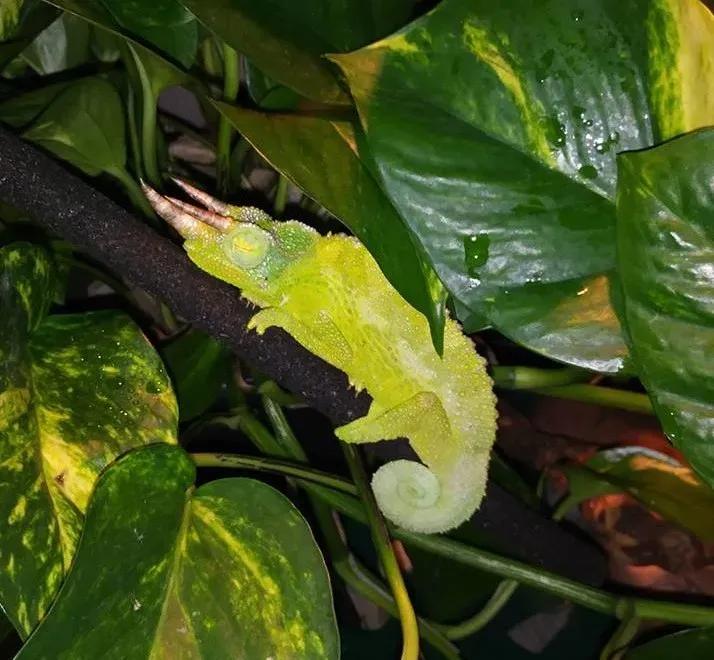
Contributed by Stacy Kitchin