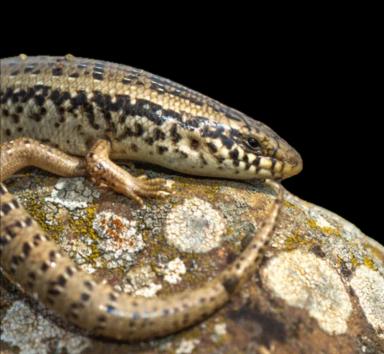
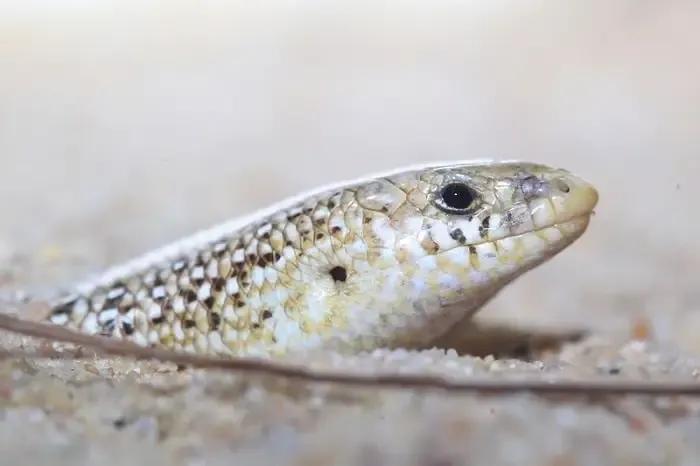
Photo courtesy of Dreamstime
Substrate is technically the material used to cover the floor of your ocellated skink’s enclosure (a.k.a. bedding). But it’s so much more than just that — while it may seem like just an aesthetic choice, for ocellated skinks, it’s a very functional and even vital part of their environment.
The most important function of an ocellated skink’s substrate is to facilitate burrowing. Because ocellated skinks are semi-fossorial, they spend a lot of their time in their substrate. This is a predator defense mechanism that makes it more difficult for potential predators to catch them, and it’s such a strong instinct that that not having access to the right substrate stresses them out (Skelton et al., 1996).
The best substrate for your ocellated skink will be one that essentially replicates what they live on in the wild. Wild observations show that they live in habitats with both packed earth and loose, sandy/stony soil. Captive observations suggest that although they are capable of making use of hideout areas, ocellated skinks seem to prefer having access to loose substrate, which is consistent with their ability to “swim” through sand. This may also be because “swimming” through fine, loose substrates facilitate movement by reducing the energetic cost of locomotion (Greenville & Dickman, 2009).
Here are ReptiFiles’ recommendations:
It takes about 45 lbs (22 quarts) of sand to create a ~3” layer of substrate in a 24” x 18” x 18” enclosure.
A layer of leaf litter on top of the substrate is useful for providing an additional texture for the skinks to burrow in, but is not required.
Avoid other substrates, such as:
Play sand can work in a pinch, but I don’t recommend it, as the grains are coarse and may irritate your skink.
NEVER use calcium sand (ex: Vita-Sand, Reptilite, Thermal Terrain, etc.). Despite the advertising, this stuff is NOT good for reptiles, and it is NOT safer than natural sand.
According to Catena & Hembree, when ocellated skinks burrow, they don’t go very far. In the study, the skinks burrow to a maximum depth of 1.65”/4.2 cm, and spent most of their time in the upper 0.79”/2 cm of substrate. So a good minimum substrate depth is going to be 2”, or 5 cm. However, deeper is useful if you plan to use live plants or create a bioactive setup.
Because they spend so much time in their substrate, ocellated skinks end up defecating in it, making spot-cleaning difficult. For this reason (and the fact that they’re not very handleable), it is my opinion that bioactive is the most efficient and least disruptive way to keep this species. The only complication with setting up an arid vivarium for ocellated skinks is that they will enthusiastically devour CUC such as isopods, mealworms, and even beetles. Giant canyon isopods, superworms, and blue death-feigning beetles may be more likely to succeed.
However, do not put your ocellated skink in a bioactive enclosure until it has passed quarantine.
If you are not using a bioactive setup, food waste, feces, urates, and contaminated substrate should be removed daily. All of the substrate will need to be fully replaced every 1-3 months, depending on the size of the enclosure and how diligent you are about daily spot-cleaning. The Zoo Med Repti Sand Scooper can be an incredibly useful tool for helping your skink’s substrate last longer!
During substrate replacement, the entire enclosure should be disinfected with a reptile-safe disinfectant like chlorhexidine, F10SC, or Rescue. Alternatively, bleach solution can be used. Use the disinfectant according to its directions for proper use, otherwise it may not be effective.
If you have a bioactive enclosure, “cleaning” is more like periodic maintenance: watering the plants, adding biodegradables and CUC food as needed, and occasionally topping up the CUC if they’re getting eaten. However, even if you’re using a bioactive enclosure, surfaces like rocks and ledges should still be routinely wiped down and disinfected.
SUMMARY —
This page contains affiliate links.