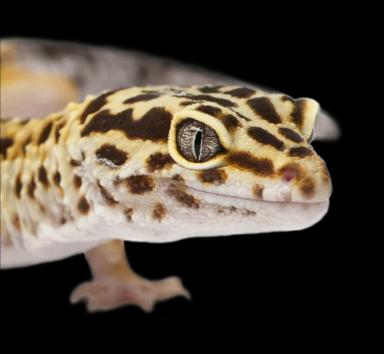
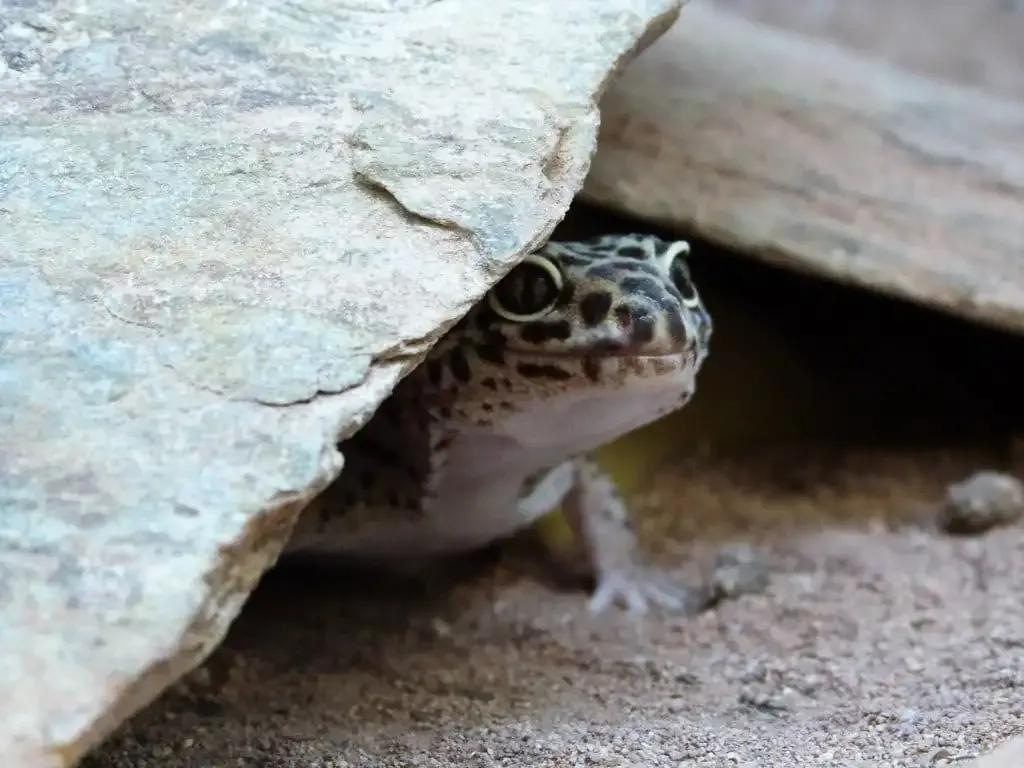
“Leopard gecko” by Lottie’s pets & stuff is licensed under CC0 1.0
There is a common myth that because leopard geckos are “nocturnal,” they don’t need any light at all to see or function, and providing light will burn their eyes. I repeat: This is a myth!
Leopard geckos are crepuscular, which means that they most active at dawn/dusk. While their eyes evolved for low light conditions, and they tend to be much more active during the night than during the day, this does not mean that they do not need lighting as part of their enclosure setup.
In fact, having a light on in the tank helps regulate their day/night cycle, which is good for their mental health and stimulates appetite. According to the UV Tool by Dr. Frances Baines, light should be provided for 14 hours/day during the summer, which simulates their optimal photoperiod. To simulate the change of the seasons, reduce the amount of light to 12 hours during winter. If you don’t want to do this manually, using a smart timer like Kasa to sync your lights with your local sunrise/sunset times also works.
Daytime light is also nice for viewing; occasionally leopard geckos will come out during the day to bask. This is not unusual — many nocturnal species have been observed basking, especially in the morning.
What about UVB?
There are three types of ultraviolet radiation produced by the sun: UVA, UVB, and UVC. UVC destroys DNA and is blocked by Earth’s atmosphere, but nearly all animals on the planet have evolved to depend on the other two wavelengths. Reptiles in particular benefit from exposure to UVA for their eyesight and UVB for healthy metabolism, specifically vitamin D synthesis and calcium metabolism.
Many leopard gecko keepers will tell you that leopard geckos “don’t need UVB.” This is partially true. Since they are most active when the sun is either weak or not present, they are not as dependent on UVA and UVB as diurnal species. However, mounting scientific evidence is proving this assumption incorrect and outdated — when offered, leopard geckos and other nocturnal species will bask under and benefit from UVB lighting.
For more information on the benefits of UVB lighting for leopard geckos, please read this paper from the March-June 2018 volume of the Journal of Herpetological Medicine and Surgery.
*UVI measurements are per recommendations from Frances Baines, D.V.M.
A Solarmeter 6.5 is required to accurately measure UVI. If you don’t have access to a Solarmeter, here is a rough estimate of the optimal distance between your basking platform and UVB lamp for leopard geckos. The following numbers assume a mesh obstruction of 30%.NORMAL PIGMENTATION (UVI 1.5-0.5)
Lamp mounted over enclosure (mesh):
Lamp mounted inside enclosure (no mesh):
HYPO-PIGMENTATION (UVI 0.7-0.5)
Lamp mounted over enclosure (mesh):
Lamp mounted inside enclosure (no mesh):
For best results, add 1-2″ to the above distance recommendations to account for your gecko’s height.
Warning: UVB bulb output declines over time, even when the visible light remains. T5 bulbs last 12 months before requiring replacement, and T8 bulbs last 6 months before requiring replacement. UVB bulbs not produced by Zoo Med or Arcadia are likely to have shorter lifespans and may not have a reliable output.
Black or red lights are not needed for nighttime heat, and can interfere with your gecko’s day/night cycle. In fact, blue lights are known to potentially damage reptiles’ eyes! It is best to save your money and not purchase one.