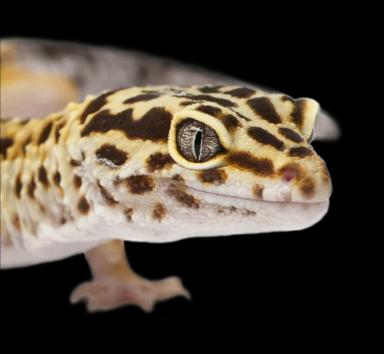
Many leopard gecko care resources still recommend that leopard geckos should be permanently housed in a 20 — or even 10 — gallon enclosure to prevent them from getting “overwhelmed” in a larger space, or stating that more room is simply “not necessary.” However, reptiles will utilize every inch of space that we make available to them, and larger, enriched enclosures encourage our pets to exercise more, which in turn keeps them healthier and helps them live longer.
As the reptile hobby comes to understand our beloved reptiles better, we are realizing that they need more room than we have been giving them in the past. For these reasons, ReptiFiles recommends that adult leopard geckos be housed in no smaller than a 36″L x 18″W x 18″H (90 x 45 x 45cm) enclosure, or at least 4.5 sq ft (0.4 sq m) of floor space. Floor space is the most important consideration here, as leos are terrestrial (ground-dwelling) lizards. That being said, they will often happily climb if appropriate vertical space and climbing materials are provided. That said, for reasons of safe lighting and heating, I don't recommend using anything shorter than 18"/45cm.
Most leopard gecko keepers prefer to house their geckos in glass aquariums or terrariums, which are attractive and can help create a more varied temperature gradient. However, if you have trouble with your temperatures, wood and PVC enclosures insulate very well and are quite popular.
ReptiFiles recommends the following commercially-available enclosures:
MINIMUM
BETTER
BEST
The sky’s the limit! Larger is always better as long as the enclosure is laid out properly.
Generally speaking, no. For the average reptile owner, keeping multiple leopard geckos in the same enclosure is not a good idea. Cohabitation can result in dropped tails, severe bite wounds, broken bones, and even the death of one or more individuals. This is particularly the case for male geckos, but can also happen within groups of females. And of course, males and females should not be housed together unless you want babies.
Pro tip: You don’t want babies.
Note for advanced keepers:
It must be acknowledged that leopard geckos do live in colonies in the wild, and they will often share resting areas or hides with other leos. However, this sharing of space is only during the day when they are asleep. During the night when they are most active, they scatter to forage so they don’t have to compete for food.
Some experts speculate that housing leopard geckos together, such as a male with two females or a small group of females, is a form of enrichment for this species. When leopard geckos are housed together, they are generally more active and demonstrate more social behaviors.
The conclusion? If you choose to house leopard geckos together, give them a MUCH larger enclosure so each can have its own territory. Also keep in mind that, much like humans, not all leopard geckos can get along with each other, so be prepared to separate them immediately into individual enclosures if they start to fight.
When in doubt, just house your leopard gecko by itself and it will be fine.
This page contains affiliate links. Income from purchases made via these links keeps ReptiFiles going strong. Thank you for your support!