UVB is a type of ultraviolet radiation naturally emitted by the sun. It’s critical to helping animals’ bodies make vitamin D3. Vitamin D3 is very important for building and maintaining strong bones, especially in diurnal reptiles. Vitamin D3 deficiency leads to Metabolic Bone Disease, discussed in the Health chapter of this guide.
Blue tongue skinks and UVB is a frequent topic of debate in the hobbyist community. It has been shown that BTS can be raised, bred, and maintained for decades without UVB, so technically it is not required for their survival. However, studies and veterinarians agree that dietary vitamin D3 and synthesized D3 (from UVB) are metabolized differently, and reptiles exposed to appropriate amounts of UVB have higher (read: healthier) levels of vitamin D in their blood as compared to those that are supplemented only.
Furthermore, UVB offers more benefits than just vitamin D, and the reptile community is increasingly coming to the conclusion that UVB should be provided to all reptiles as part of helping them thrive (not just survive) in captivity. Best practice in blue tongue skink care is to provide appropriate UVB lighting.
Zoo Med and Arcadia are the only UVB brands recommended by ReptiFiles. These are appropriate for use on top of or inside 18-24″ tall enclosures, and should be long enough to span half of the enclosure’s total length. In order to use these bulbs properly, they will need to be replaced every 12 months even if they seem to be working fine, since UVB output declines over time even though light output doesn’t. For the safety of the skink, it should be able to get no closer than 10″ to the bulb.
Also, make sure that the fixture doesn’t have a piece of glass or plastic to “protect” the bulb. UVB rays are blocked by glass and plastic, rendering that bulb you just spent so much money on completely useless. Naked UVB bulbs are effective UVB bulbs!
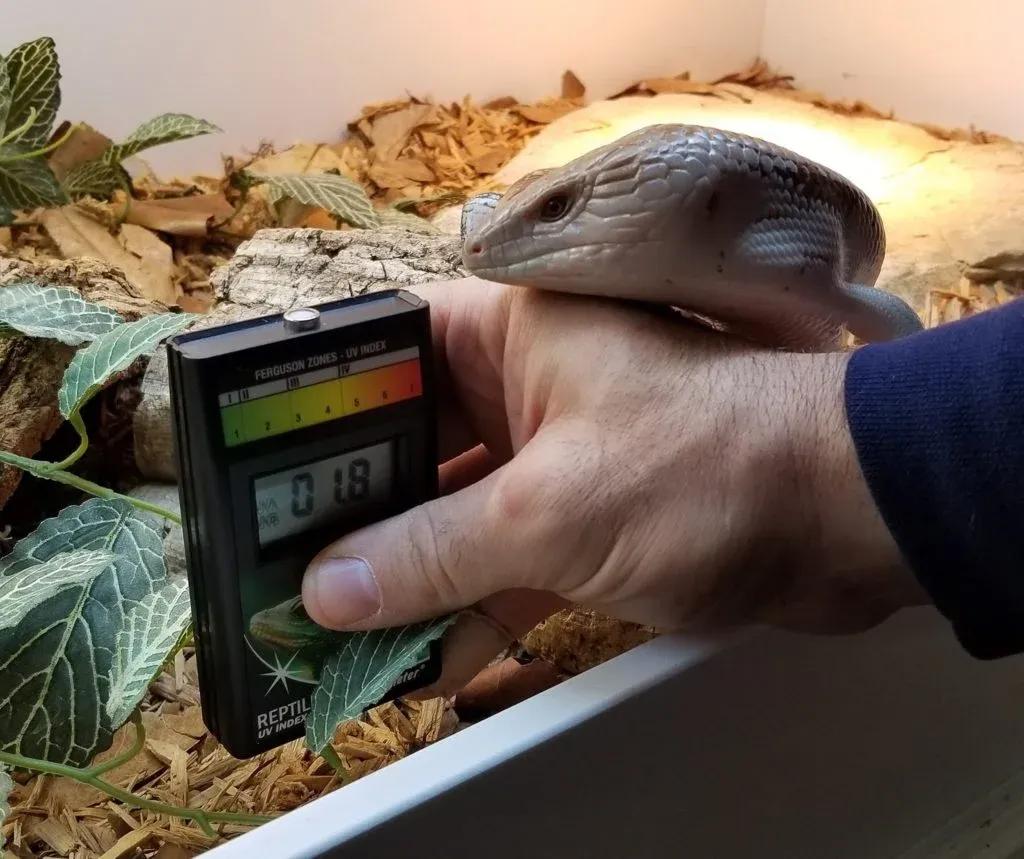
If you have a Solarmeter 6.5 (strongly recommended) to measure your lamp’s UVB output, shoot for a UV Index reading that ranges between 3.0-4.0 in the basking area. If you don’t have a Solarmeter, here is a rough estimate how far away your skink’s back should be from the UVB bulb during basking:
With mesh obstruction:
Without mesh obstruction:
Different T5 HO bulb fixtures affect the amount of UVB your skink will receive from the bulb differently. The distance given above are only accurate if the bulb is mounted in an Arcadia ProT5 or Vivarium Electronics T5 HO fixture.
UVB bulbs decay over time, so even if it still appears to be producing visible light, it may not be producing UVB! Make sure to change out your bulb every 12 months to maintain good UVB output.
Since blue tongue skinks are diurnal, it’s helpful to provide plenty of “sun”light to stimulate activity, appetite, and general wellbeing. Aside from using a UVB tube, this can be accomplished by using a 6400K LED or pair of fluorescent lights of the same length. These lights and their fixtures are usually pretty easy to source, and will make a big difference in the function as well as attractiveness of your setup.
Contributed by Cole Schramm