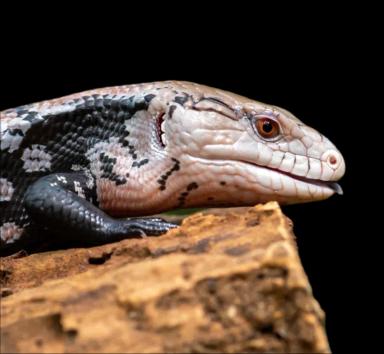
Since blue tongue skinks are cold-blooded, they rely on their environment to provide the heat needed to function. The best way to achieve this is to provide a temperature gradient so the skink can self-regulate according to his/her needs. Use a temperature gun like the Etekcity Lasergrip 774 for instant, accurate information on your skink’s environment.
Use a cluster of at least two high-wattage halogen flood bulbs inside of a dome heat lamp with a ceramic socket to safely achieve the right basking temperatures and thermal gradient. You can find the bulbs you need at the hardware store or pet store, but be sure to get halogen flood bulbs rather than rounded house bulbs. Halogen bulbs tend to last longer and burn hotter, so although they’re more expensive, they’re a better investment.
For the average 24″ tall enclosure, a 75w bulb should achieve the temperatures you need. I recommend the Arcadia Halogen Heat Lamp or Zoo Med Repti Tuff Splashproof Halogen for the job. If you find that gets a bit too hot, use a plug-in lamp dimmer to dial down the heat. If you still have trouble achieving the right surface temperature, try raising the basking area closer to the heat bulb or switching to a higher wattage bulb.
At average household room temperatures, blue tongue skinks generally do not need any kind of lighting or heating during the night. Some people prefer red or black bulbs for providing nighttime heat, but it’s actually healthier for skinks to experience a nightly temperature drop. However, without adequate daytime warming, these cool temperatures may induce brumation or illness.
If you need to heat your enclosure at night because it gets too cool, use a non-light emitting heat source like a ceramic heat emitter or radiant heat panel to warm the enclosure to an appropriate air temperature (not basking temp). These heat sources are not appropriate to use during the day, however.
Don’t forget to use a basking stone! In my experience I noticed dramatic improvements in my skinks’ activity and behavior after adding the stone, and I regret not installing one sooner. Take a piece of slate tile or flagstone and place it underneath the heat lamp. The stone will absorb heat from the lamp, providing warmth from both above and below in the same way that blue tongue skinks prefer to bask in the wild. If you want to have a healthy blue tongue skink, this is not an optional piece of terrarium furniture.
Never use a heat rock! These are not the same as a basking stone, since they are heated from inside with electrical wiring. Heat rocks are infamous for burning reptiles, so long story short: don’t do it.