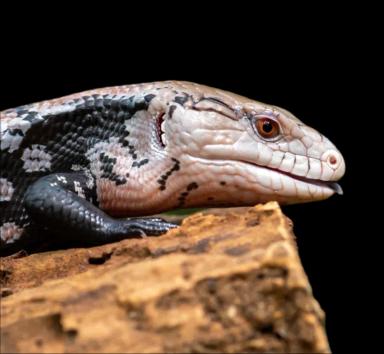
Blue tongue skink

Blue Tongue Skink Care Guide

Blue Tongue Skink Humidity Requirements

Maintaining the right humidity is important for helping your skink shed easily, as well as prevent illnesses like respiratory infections. As a general rule, Australian species thrive around 40% humidity, and Indonesian species require 60-80% humidity. However, this still varies depending on what species you have:

  • T. gigas evanescens (Merauke) — 60-80%
  • T. gigas gigas (Classic Indonesian) — 60-80%
  • T. gigas gigas (Halmahera) — 60-80%*
  • T. gigas keyensis (Kei Island) — 60-80%
  • T. nigrolutea (Blotched) — 40-50%
  • T. multifasciata (Centralian) — 20-40%
  • T. occipitalis (Western) — 20-40%
  • T. scincoides chimaera (Tanimbar) — 60-80%
  • T. scincoides intermedia (Northern) — 40-60%
  • T. scincoides scincoides (Eastern) — 40-60%
  • T. rugosa (Shingleback) — 20-40%
  • T. sp. (Irian Jaya) — 60-80%

*You didn’t read this wrong — updated husbandry recommendations from Indonesian BTS experts like Amaryllis Bekk now list the Halmahera “locality” with other Indonesians for humidity requirements.

The best way to keep track of ambient humidity (and air temperature) is with a digital hygrometer like Zoo Med’s Digital Thermometer and Humidity Gauge Combo. Put the probe on the cool end of the enclosure and target the higher end of the animal’s humidity range. Enclosures tend to have humidity gradients just like they have temperature gradients, and trying to get the whole thing to have uniform humidity is an exercise in futility. Fortunately, that’s not how nature works, and reptiles know how to seek out places of higher/lower humidity as needed, so it works out.

A good rule of thumb for making sure your enclosure is humid enough is by checking your skink’s belly scales. If they’re rough, you need more moisture. If there’s nice and silky smooth and the skink is shedding well, you’re doing okay.

Tricks for maintaining humidity

Even when you use the right substrate, maintaining high levels of humidity can be tricky.

  • Use a thick layer of substrate — at least 4″. The more substrate you have, the more moisture it can hold. 
  • Another trick is to set aside time each week to manually mix water into the substrate until it’s damp, but not wet. While misting only touches the surface, having moisture in the substrate stabilizes humidity for longer periods of time.
  • Daily misting (preferably in the morning and/or at night) with a traditional spray bottle can give you hand cramps, so use a pressure sprayer like the Exo Terra Pressure Sprayer to make life a lot easier. 
  • Install a humid hideout somewhere in the middle to cool end of the enclosure. This will ensure that your skink has somewhere humid to retreat to during the day/night as needed. Simply line a reptile hide or cave with moistened sphagnum moss to encourage humidity levels near 100%, and replace the moss frequently to prevent mold from developing.

What if you’re still struggling with humidity? If you’re on a tight budget, get a humidifier like the ReptiZoo Reptile Fogger. However, personally I recommend investing in an automatic misting system like the MistKing Starter system, as you’ll get more lasting humidity effects which will be better for your skink’s long-term health.

Here are 3 rules for using a reptile fogger successfully:

  1. Don’t run it 24/7. The enclosure needs to go through cycles of wet and dry to keep pathogen populations from going wild.
  2. Clean the entire unit at least 1x/week with F10SC or Rescue veterinary disinfectant to prevent bacterial growth.
  3. Always use distilled or reverse osmosis water, never tap.