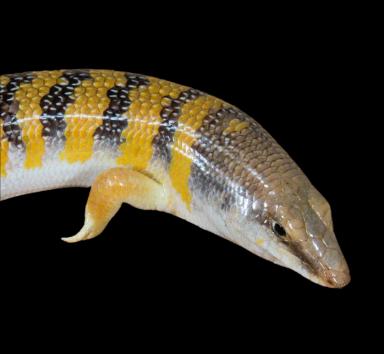
Sandfish skinks are diurnal, which means that they are most active during the day, and they need exposure to visible light and UVB rays in order to be healthy. Of course, unless you have a strategically-placed hole in your roof, natural, unfiltered sunlight is a little difficult to get indoors. Fortunately you can replicate it with a high quality fluorescent tube UVB lamp placed over the lid, about 1/2 to 2/3 of the length of the enclosure. For a 20 gallon enclosure, for example, that would be an 18-24” lamp.
Sandfish are native to northern Africa and the Arabian peninsula, and these areas experience intense sunlight, and correspondingly intense UV readings. Herpers have noted, however, that wild sandfish are typically most active above the sand in the morning and evening, which is when UVI is relatively low. As such, they are classified under Ferguson Zone 1. If you have a Solarmeter 6.5 (recommended), the UVI on the basking surface should be between 1.0-2.0 (personally I prefer to provide the higher end of this range). UVI should be highest at the basking spot and lower in other areas of the enclosure so your lizard has options to choose from.
If you don’t have a Solarmeter, here’s a fair guide to distancing with each bulb type. The given distances are the optimal distance between the lamp and the sandfish’s back when basking:
The above estimations assume a ~35% mesh block and come from bulbs installed in Arcadia ProT5 or Vivarium Electronics fixtures. For more details on adjusting basking distance based on mesh obstruction, see the Facebook group Reptile Lighting > Guides > Guide 1: Using T5-HO lamps above a Mesh Screen.
Due to reported unreliability in performance, ReptiFiles does not recommend ANY other brand of UVB bulb at this time. Using other brands of UVB lighting without the use of a Solarmeter 6.5 may negatively affect your sandfish’s health.
Note: Make sure that your UVB lamp fixture doesn’t have a piece of glass or plastic to “protect” the bulb. UVB rays are blocked by glass and plastic, rendering that bulb you just spent so much money on completely useless. Naked UVB bulbs are effective UVB bulbs!
UVB bulbs decay over time, so in order to maintain consistent performance, you will need to replace your bulbs every 12 months. Even if your lamp is still producing light, that doesn’t necessarily mean that it’s working — UVB lamps can still produce visible light even when they’re producing very little UVB!!
Considering that sandfish are generally considered to be diurnal (day-active) and mid-day baskers, it is reasonable to assume that they prefer and are stimulated by the presence of bright light in their environment. This assumption is supported by captive observations.
Although UVB lamps and heat lamps (we’ll get to that later) do produce some visible light, they simply don’t produce enough of it to get anywhere close to replicating daytime illumination. For this reason, ReptiFiles strongly recommends adding 6400K or similar full-spectrum T5 HO fluorescent or LED lighting to further illuminate your enclosure.
Here are ReptiFiles’ favorite “daylight” lamps for a 30″ long sandfish terrarium:
DO NOT use colored lights of any kind with your sandfish (red, black, blue, etc.), not even during the night. These can potentially negatively affect your lizard’s mental health by altering their perception of color in their environment. And honestly, it looks weird and unnatural.
Keep the lights on for 12 hours/day. You can do this by manually turning the lights on and off or by putting them on a timer (I’m in love with smart timers right now! Currently I’m using Kasa smart strips).