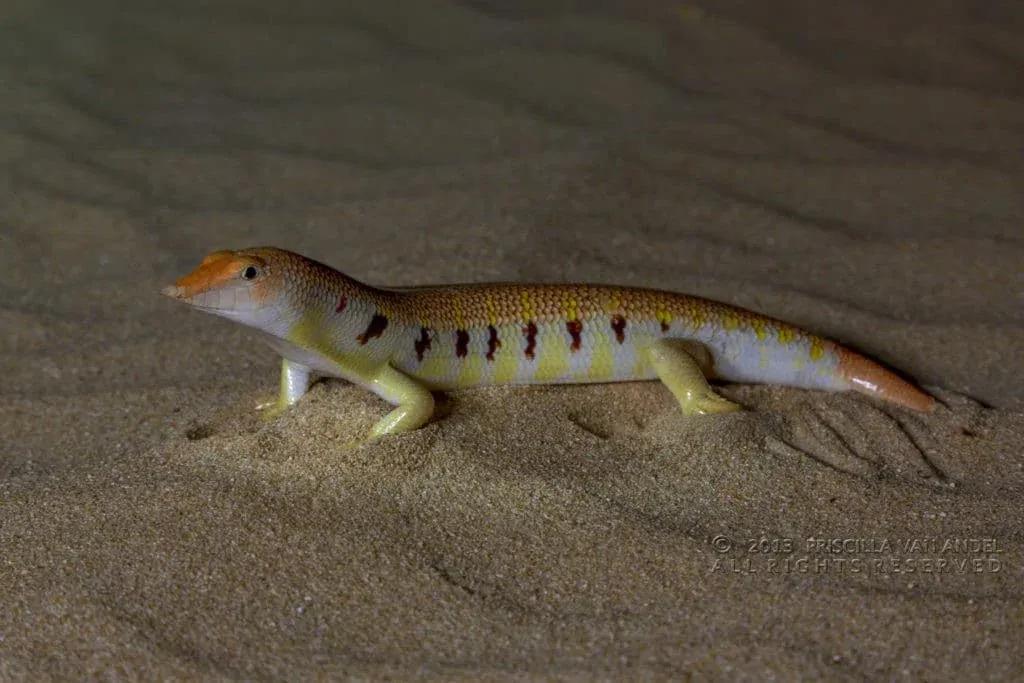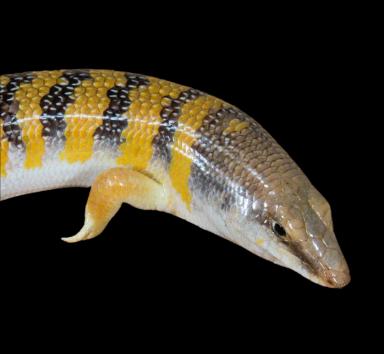
Sandfish skinks are native to the scorching deserts of northern Africa, so they prefer very high basking temperatures:
The total thermal gradient from basking/warm side to cool side should have temperatures ranging between 140°F to 80°F during the day. For best results, measure temperature a few hours after the heat source has turned on.
Heat sources should be turned off at night so temperatures can drop to 70-80°F (21-26°C).
Sandfish skinks do not need colored light bulbs (red, blue, black, purple, whatever) for “extra heat” at night, and using these can prevent your skink from sleeping well. Contrary to popular belief, reptiles can see red light. How would you like it if someone left the light on while you tried to sleep?
A heat lamp! Heat lamps are the most natural way to create heat for your sandfish because they mimic the way that the sun provides light and heat from above, warming both the air and ground beneath.
If you are using a glass terrarium or other enclosure with a mesh top, I recommend using a dome-style heat lamp fixture with a ceramic socket and built-in lamp dimmer or a dual dome fixture plugged into a rheostat. I prefer:
There are many different types of heat bulbs available, from reptile-specific brands to floodlight bulbs at your local home improvement store. These are my preferred bulbs for heating sandfish skinks:
If you find yourself frustrated by reptile heat bulbs that keep burning out in less than 2 months, it probably means that you’re either not using it correctly or you bought a defective bulb. Here’s what you should do:
This is a common question with no solid answer, sorry! Generally speaking, if you have 6” of sand in a 12-18” tall enclosure, then a 50w halogen should be plenty, and possibly more than enough. Exactly what wattage bulb you will need depends on room temperature, enclosure height, substrate depth, and which bulb you’re using.
If you need more distance, try raising your lamp further above the enclosure with the Zoo Med Reptile Lamp Stand.
ReptiFiles does not recommend using ceramic heat emitters (CHEs), heat pads, heat tape, or radiant heat panels with this species, as they simply don’t get hot enough for a sandfish’s needs without becoming dangerous.
The best way to measure the temperature of the sand in your enclosure (which is going to be where your sandfish feels the heat) is with an infrared thermometer, aka temp gun. Without getting too technical, this device measures the temperature of surfaces rather than the air like traditional thermometers. For a sandfish that spends most of its time underground, surface temperature is much more important than air temperature.
→ ReptiFiles recommends: Etekcity Lasergrip 774
A digital probe thermometer can be good for measuring air temperature, but analog stick-on thermometers tend to be grossly inaccurate and can put your skink’s health at risk.
A temperature gradient (sometimes also called a thermal gradient or heat gradient in this hobby) is the range of temperatures within your reptile’s enclosure. As ectotherms (cold-blooded animals), reptiles can’t control their body temperature like humans can. Instead, they rely on the temperature of their environment to regulate their body temperature. But instead of seeking one perfect temperature all the time, they move from warm areas to cool areas and back again, depending on what they need.
In order for your sandfish to be healthy, it needs a temperature gradient in its enclosure. The easiest way to do this is by putting the heat lamp on one side of the cage. The side underneath the heat lamp then becomes the warm side, while the opposite becomes the cool side. Temperatures between the two sides will naturally flow from high to low depending on distance from the heat lamp.