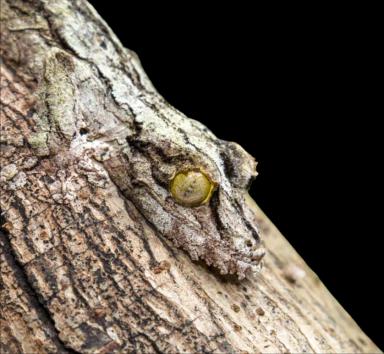
Although some may try to tell you that leaf-tailed geckos can be “happily” kept at room temperature, the fact of the matter is that these geckos are still poikilothermic like other reptiles, which means that they need adequate opportunity to thermoregulate according to their needs. Furthermore, different species evolved to thrive at slightly different temperatures, depending on what part of the island they inhabit. All seem to benefit from a temperature drop at night, which also helps promote air circulation in glass enclosures.
The below temperature recommendations are sourced from Leaf-tailed Geckos — The Complete Uroplatus by Philip-Sebastian Gehring (2020).
The best heat source for a leaf-tailed gecko is a heat lamp. White or clear low-wattage incandescent/halogen bulbs work very nicely for daytime heating. Ceramic heaters and heat projectors are less optimal, and colored bulbs should be avoided entirely.
In implementing the above recommended temperatures in your leaf-tailed gecko terrarium, your heat lamp should create an area of warmth that is roughly equal to the maximum daytime temperature specified by these numbers (unless a higher basking spot temperature is indicated as optimal). This will help create the ideal temperature gradient for your gecko to thermoregulate with.
If you are using a small terrarium hood like the Zoo Med Naturalistic Terrarium Hood to house your lights, I recommend the Exo Terra Daytime Heat Lamp. The exact wattage you need will depend on enclosure size, design, room temperature, and other factors, but start with the 25w and go up or down from there depending on your needs.
If you are using a small 5.5″ dome lamp like Zoo Med’s for your heat bulb, then I recommend starting with the 25w Zoo Med Repti Basking Spot Lamp.
Track your terrarium’s temperatures by using at least one digital probe thermometer with the probe placed in the basking area. Another thermometer should be placed in the shade in the middle of the setup to make sure your ambient temps are staying within the safe range.
For additional help with controlling your temperatures, rheostats and proportional thermostats are very handy for preventing overheating. Rheostats (lamp dimmers) are more hands-on than thermostats, which make adjustments automatically.
If you are struggling with low daytime temperatures in your enclosure, you will need to add another heat bulb or switch to a higher-wattage bulb.