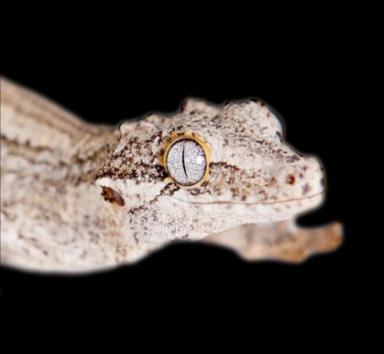
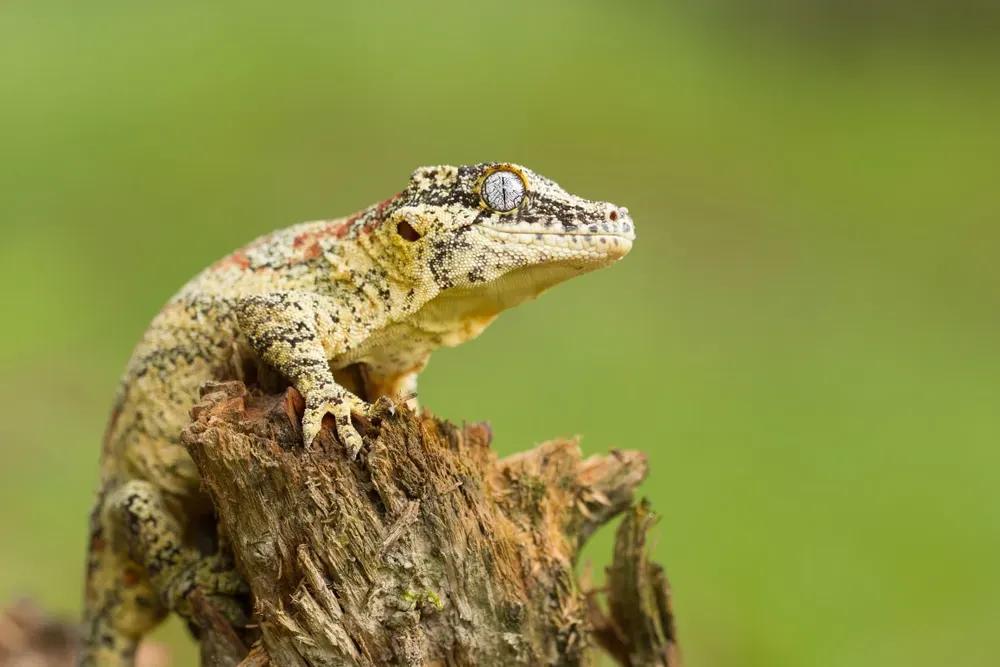
Gargoyle geckos are nocturnal, being most active between 1-4 hours after sunset (Snyder, 2007).
Although gargoyle geckos are nocturnal, they still benefit from some kind of light during the day. Aside from improving viewing, providing a source of daylight helps regulate their day/night cycle, and can improve activity, appetite, and overall health. For best results, lights should be on for 12 hours/day.
Gargoyle geckos benefit from a low-intensity basking spot, which is most easily created with an incandescent bulb (more on that in the Temperatures section ↓).
Don’t both with black/blue/red light bulb for night viewing or supplemental heat. Gargoyle geckos’ eyes function perfectly in the dark, and providing light at night can actually mess with their day/night rhythm. Also, nightly drops in temperature are actually healthier than providing heat at night. My opinion? Save yourself a few bucks and don’t bother.
Many people will tell you that UVB is not necessary for gargoyle geckos in captivity—that they get all the vitamin D3 they need from high quality prepared diets. While it is true that not having access to UVB won’t necessarily kill a gargoyle gecko, there is a growing body of evidence that providing UVB substantially increases health and quality of life for reptiles previously thought not to “need” it. Furthermore, according to Snyder et al., gargoyle geckos are known to occasionally bask during the day.
ReptiFiles recommends UVB lighting for all reptiles, including gargoyle geckos. Since gargs are crepuscular and typically hide behind leaves during the day, they are classified under Ferguson Zone 1, which means you don’t need anything particularly strong. If you have a Solarmeter 6.5 (recommended), the UVI at the basking branch should be between 1.0-2.0. If you don’t have a Solarmeter, here’s a fair baseline for distancing with each bulb type:
These estimations assume that the UVB lamp is placed above the terrarium mesh rather than inside the enclosure, assuming a ~35% mesh block. For more details on adjusting basking distance based on mesh obstruction, see the Facebook group Reptile Lighting > Guides > Guide 1: Using T5-HO lamps above a Mesh Screen.
Note: If you use UVB, make sure that the fixture doesn’t have a piece of glass or plastic to “protect” the bulb. UVB rays are blocked by glass and plastic, rendering that bulb you just spent so much money on completely useless. Naked UVB bulbs are effective UVB bulbs!
The short answer is no, gargoyle geckos do not need a “nighttime” light source — particularly not blue-tinted bulbs, as blue light is known to disrupt circadian rhythm in vertebrates.
The longer answer is that in Snyder et al.’s 2007 study, gargoyle geckos were observed to be more active during brighter nighttime conditions because it helped increase their hunting success rate. However, no bulb on the current market accurately replicates the warm, extremely dim light of moonlight, and according to reptile lighting expert Dr. Frances Baines, the ambient light in an average human home at night is likely to be plenty for a nocturnal reptile to see by.
Hatchling gargoyle geckos (under 13g) are often housed in small “grow-out” enclosures to keep track of their health during this vulnerable phase of life. If you have or are planning to get a hatchling gargoyle gecko, there are some special accommodations you will need to make in terms of UVB lighting and heating.
If you put a UVB lamp on top of a hatchling’s tiny grow-out cage, you will likely expose it to dangerously high levels of UV. To keep your hatchling safe while still providing the benefits of UVB light, use a forest-strength compact coil bulb in a 5.5″ dome fixture hung from a reptile lamp stand. Turn off the light at night.
Specific products ReptiFiles recommends for hatchling lighting:
This page contains affiliate links.