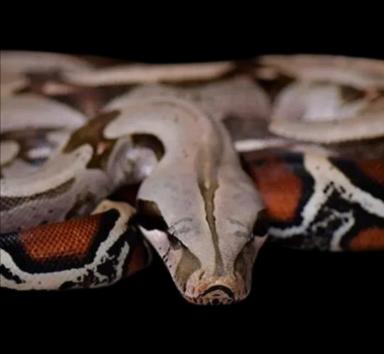
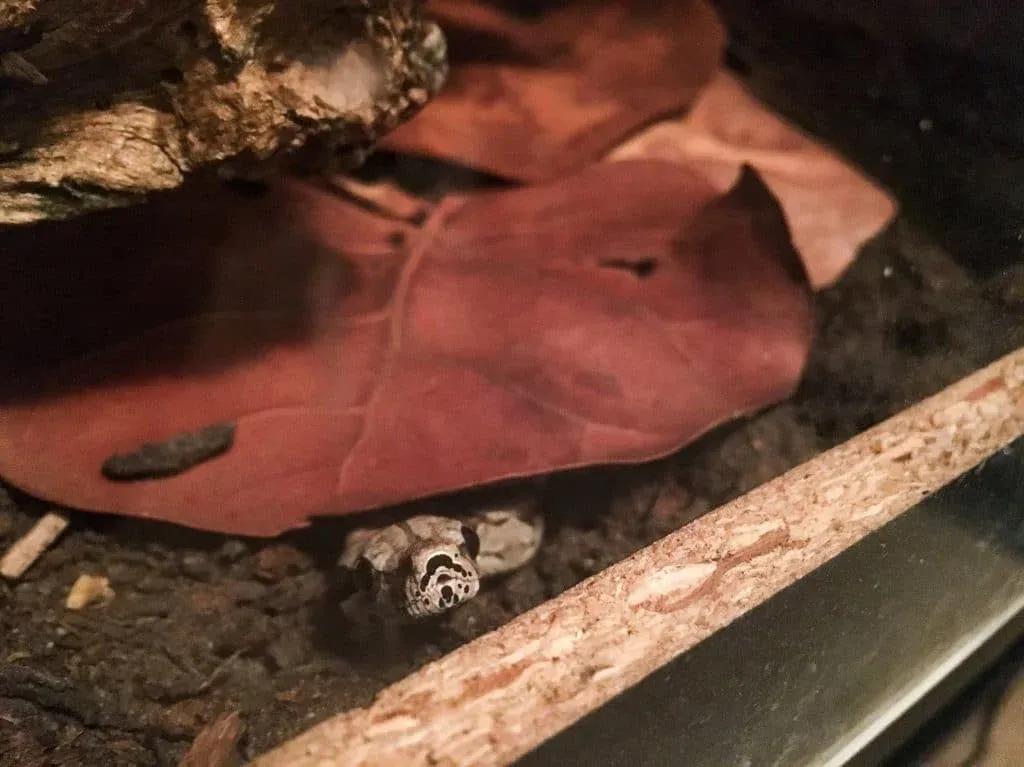
“Substrate” is another word for bedding — the material used to cover the floor of your pet’s enclosure. Boa constrictors are semi-arboreal, which means that although they do like to spend time in trees and branches, they also spend time on the forest floor and will occasionally burrow. If your snake seems to have gone missing, double check the substrate — you might find a pair of mischievous eyes peeking out at you!
Boa constrictors should have at least 2” (5 cm) of substrate, depending on snake size, but thicker is better because it facilitates better burrowing as well as holds humidity more efficiently. Personally I prefer at least 3 inches.
Sphagnum moss and dead leaves are highly recommended for layering on top of substrate to provide variety and further enhance your enclosure’s ambient humidity. Plus, they make the enclosure look very naturalistic!
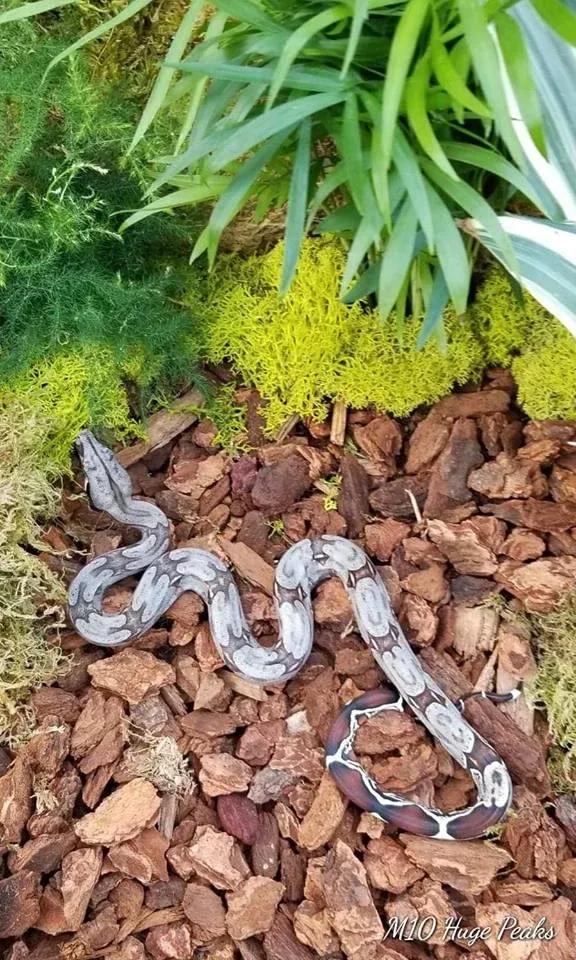
Photo contributed by Jed Rice
Some keepers have made these substrates work, but I don’t personally use or recommend them. That said, paper and disposable towels make an excellent substrate for a boa in quarantine.
These substrates pose real risk to your boa’s health and/or are not absorbent or good for maintaining humidity. Never use these substrates for a boa.
Pine/cedar products (source)
Impaction is a condition where a reptile’s digestive tract gets blocked by foreign material. This is most often caused by substrate ingestion. However, wild reptiles ingest soil and sand all the time in their natural habitat, so why aren’t they dying from it?
Impaction isn’t only caused by substrate ingestion. It is also closely associated with low temperatures, dehydration, and large or expandable particles. This isn’t usually a problem for wild reptiles because they have adapted perfectly to the conditions of their natural environment. However when foreign matter is used as a substrate in captivity or we fail to provide sufficiently high temperatures or humidity, impaction becomes a problem.
If your temperatures and humidity are correct and your boa is otherwise healthy, you shouldn’t have to worry about impaction. However, it is worthwhile to take precautions where reasonable. Make sure your boa ingests as little substrate as possible during feeding, especially if your boa is young and if you are using a wood-based substrate.
Spot cleaning to remove feces and replace substrate soiled by urine should be performed often, at least once a week.
Deep cleaning should not occur more than once every 3-6 months. You can use a 10% bleach solution, Rescue, or F10SC disinfectant to do so. Rinse until no fumes remain. Undiluted vinegar or lemon juice is particularly effective for removing hard water spots from glass, but neither is effective as a disinfectant.
Total substrate replacement should also be performed every 3-6 months as needed, unless your enclosure is bioactive. If your enclosure is functionally bioactive, years may pass between cleanings.
Although it may seem counterintuitive, reptile enclosures do not need to be deep cleaned every week or even every month. Sterile conditions weaken a reptile’s immune system, making it more likely to get sick, not less. The only time it is appropriate to clean a reptile’s enclosure frequently is if the animal is ill and/or in quarantine.