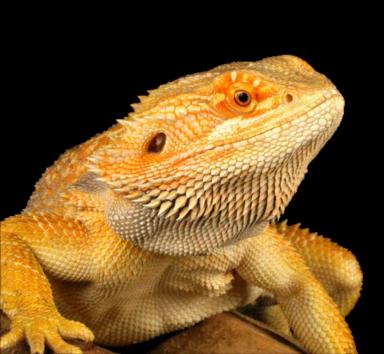
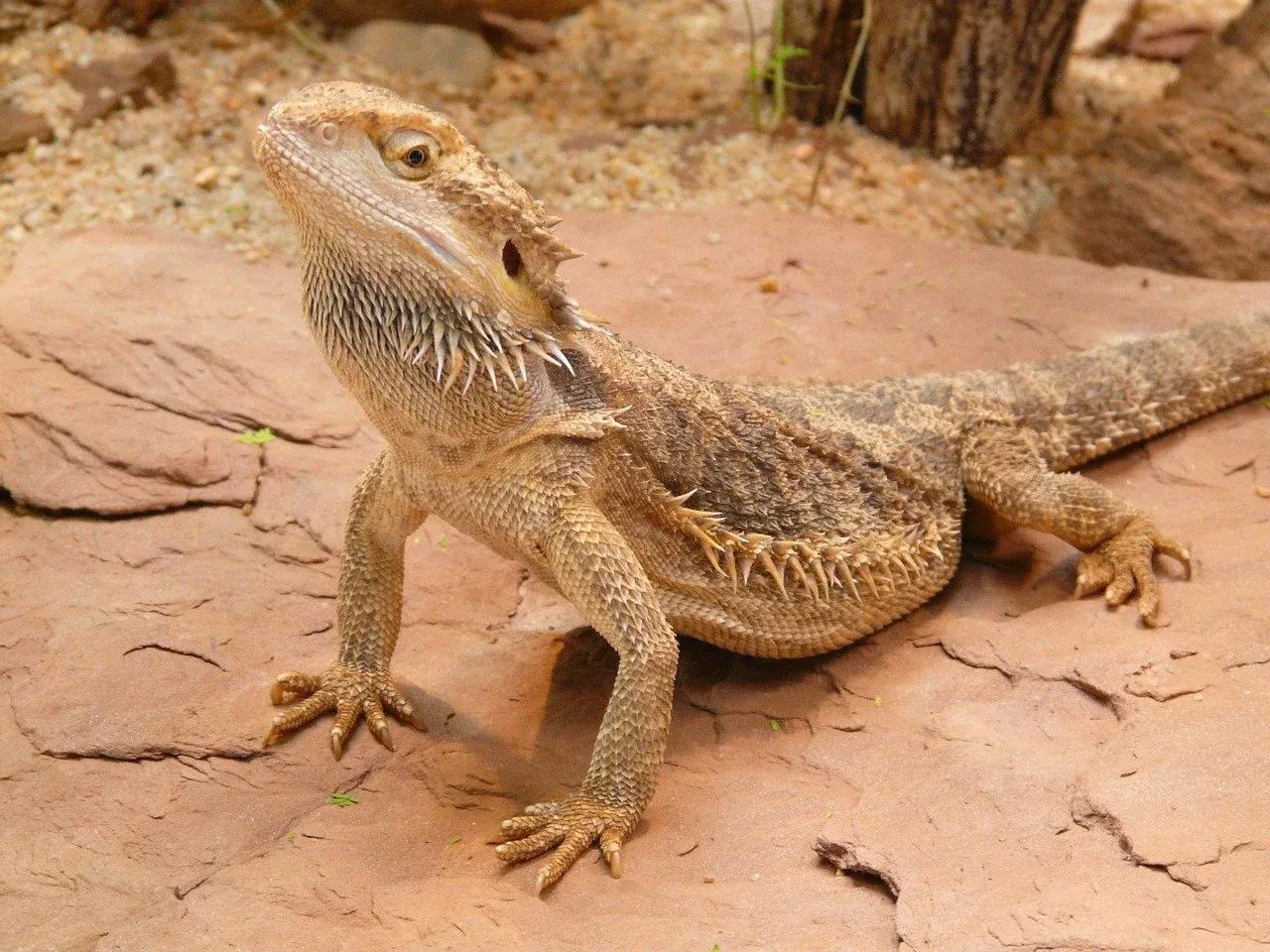
Like all reptiles, bearded dragons need heat to digest and maintain their immune systems. Without it, they get sick and die. Since bearded dragons are basking lizards, they use heat most effectively from an overhead heat source that mimics the sun.
Since they are cold-blooded, bearded dragons need a temperature gradient in their enclosure in order to be able to regulate their body temperature. Although they can tolerate very high basking temperatures, they need to be able to escape to cooler areas in the enclosure to prevent overheating. For example, if we were looking at an average enclosure from left to right, the highest temperatures should be at the far left, gradually descending to the lowest temperatures on the far right.
The recommended basking surface temperature shown above is based on recommendations in Judish Badham’s 1971 PhD thesis, A comparison of two variants of the bearded dragon, Amphibolurus barbatus (Cuvier) (since then verified by Dr. Jonathan Howard), where rectal temperatures of P. vitticeps were taken when the dragons moved away from the sun, showing that they were done basking for the moment, and presumably having reached optimal temperature. Their findings indicated that the optimum core body temperature of central bearded dragons is 36.3°C (97.3°F), which requires basking site temperatures between 42-45°C (108-113°F) to achieve. Dr. Howard’s basking substrate surface temperature measurements suggest that the basking surface in a bearded dragon enclosure does not need to exceed 50°C (122°F), as this risks overheating the enclosure.
What should you use for a basking surface?
Surfaces like rocks and logs tend to collect heat over the course of the day, becoming significantly warmer than the surrounding air (for example — have you ever burned yourself on a seat belt buckle even though the air in your car wasn’t that hot?). According to a study by Jane Melville and James Schulte, active body temperatures in Central Australian agamid lizards correlate closely with surface temperatures, which means that measuring basking surface temperature is very important (more on how to measure surface temperature later). For these reasons, a light-colored stone basking surface should be provided, as this material is best at absorbing heat for bearded dragons to use. That said, sturdy basking branches also perform well.
Is it safe for a bearded dragon to have low nighttime temperatures?
Most reptiles benefit from a nightly drop in temperature, which science suggests may promote a healthy metabolism and even strengthen the immune system (rather than weaken it, as commonly believed). Provided that daytime temperatures are correct, pet bearded dragons can handle nighttime drops as low as 50°F without ill effect. In fact, providing cooler temperatures at night encourages beardies to bask in the morning, which subsequently makes for a more active dragon. However, without adequate daytime warming, these cool temperatures may induce brumation or illness.
Use a high-wattage halogen bulb inside of a dome heat lamp with a ceramic socket to safely achieve the right basking temperatures and thermal gradient. ReptiFiles recommends using a cluster of at least 2 halogen flood bulbs to provide high-quality Infrared A and B radiation to help your pet thermoregulate most efficiently. I recommend the following bulbs:
Wattage = heat output. Whether you're using a 4'x2'x4' or 6'x2'x2' enclosure, 90-100w should achieve the temperatures you need. If you need hotter, raise the basking surface (preferably light-colored stone rather than plastic, mesh, or fabric) closer to the heat source. If basking temperature is too low, move the basking surface further away or use a lower-wattage bulb.
When setting up a large reptile enclosure, chances are good that basking bulbs alone won’t be enough to create the temperature gradient that your pet needs. If this is the case for your enclosure, you will need to add secondary heat sources to boost your ambient temps.
It’s best to use lightless heating for this purpose, such as:
Use whatever wattage works best to maintain appropriate minimum ambient temperatures — although generally speaking, this means you should be looking at the lowest-wattage options. Depending on the size of your enclosure, you will need 1-2 ambient heaters.
For enclosures taller than 3′, you may need to get handy and install your ambient heating under a ledge about halfway down the enclosure to make sure the cool zone isn’t prohibitively cold during the day. Radiant heat panels work particularly well for this purpose, as they are built specifically to prevent contact burns.
Heat panels and heat projectors should be controlled via rheostat or dimming (proportional) thermostat. Because they produce IR-B and IR-C, you don’t have to worry about negative effects from dimming too much. Ceramic heat emitters are less sensitive and can be controlled via rheostat or on/off (non-proportional) thermostat.
First, you need to make sure that you’re getting the right surface temperatures. To measure this, you will need an infrared temperature gun. I got an Etekcity Lasergrip 774 off Amazon, and it’s spectacular.
While using your temp gun, make sure that the basking temperatures cover an area at least as large as the dragon’s entire body (including tail), as hot spots can be dangerous. And don’t take temperature readings until the heat source has been going for about 3 hours, as earlier or later will give you an inaccurate reading.
Second, you need to make sure that your air temperatures are high enough. A warm basking surface is no good if the air is too cold, and too high air temperatures can give your dragon heat stroke. Keep track of the air temperature in the basking area with a probe digital thermometer like the Zoo Med Digital Combo Thermometer and Humidity Gauge, which is inexpensive and I have been quite pleased with in my own use.
You need both a temp gun and digital thermometer to get a complete and accurate picture of your bearded dragon’s thermal gradient. One should not be used without the other!