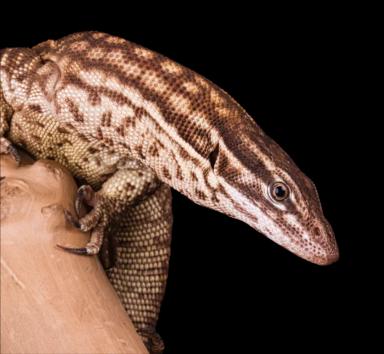
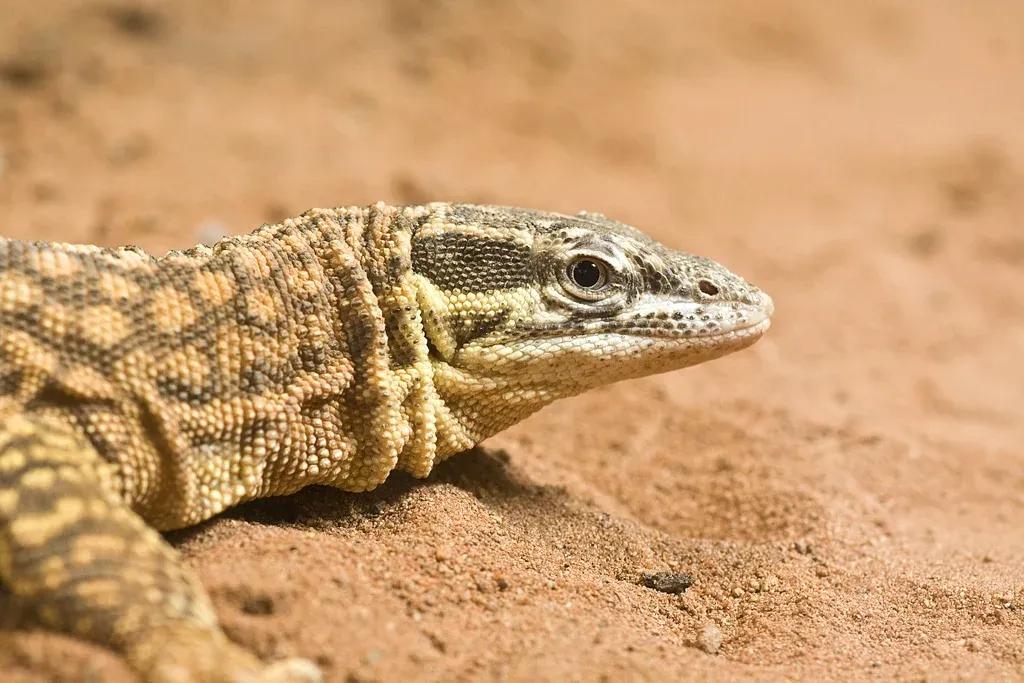
"Spiny-tailed monitor (Varanus acanthurus)" by Frupus is licensed under CC BY-NC 2.0
Substrate is technically the material used to cover the floor of your ackie’s enclosure (a.k.a. bedding). But it’s so much more than just that. While it may seem like just an aesthetic choice, for ackie monitors, it’s a very functional and even vital part of their environment.
Ackie monitor substrate’s most important function is to facilitate burrowing. This is because burrowing is an instinctive behavior that evolved from living in a hot, dry habitat. But even in captivity, burrowing still has health benefits. Providing a deep substrate for your ackie to burrow in helps prevent overheating, promotes healthy hydration, and even helps keep nails filed down.
The best substrate for your ackie monitor will be one that essentially replicates what they live on in the wild. If you look at photos of wild ackies posted on iNaturalist and Flickr, you will see that they live on packed sand and sandy/stony soil. Here are some substrates that do a good job of replicating what they have in the wild:
Whichever substrate you choose to use, make sure to mix it with water until it is wet enough to clump. Adding powdered clay to the mix (no more than 20% of the total substrate), such as bentonite clay or Zoo Med Excavator Clay, can help your substrate hold burrows more readily.
Avoid other substrates, such as:
Play sand can be used by itself in a pinch, but in my experience it doesn’t seem to hold burrows as well as the options listed above.
NEVER use calcium sand (ex: Vita-Sand, Reptilite, Thermal Terrain, etc.). Despite the advertising, this stuff is NOT good for reptiles, and it is NOT safer than natural sand.
Ackies will dig as deep as you let them. According to Varanus acanthurus (Spiny-tailed Monitor Lizard). Communal nesting and commensalism by J. Sean Doody et al., ackie nests have been found at depths of 31-98” (80-250cm). However, such deep burrows don’t seem to be a requirement. According to a report by Grant Husband mentioned in the same paper, an ackie nest has been found at just 16”/40cm. I speculate that the depth to which a nesting ackie monitor will dig has something to do with local soil moisture content.
In captivity, a good minimum depth is 12”/31cm for males and 18”/46cm for females. However, deeper is definitely better! A reasonable “ideal” ackie monitor substrate depth to shoot for would be around 24”/61cm.
Why do females need deeper substrate? Because female ackie monitors often lay infertile eggs in captivity, so if even if you don’t plan to breed your ackie, you need to make sure that the substrate is deep enough for her to feel comfortable laying her eggs. If the substrate isn’t deep enough, she may choose to retain her eggs instead, leading to egg-binding and potentially death.
Because ackies spend so much time burrowing, you may wish to have a glass substrate barrier so you can observe your ackie while it goes about its business underground. To preserve privacy, it may be a good idea to install one-way film on the inner surface of the glass.
There’s a common misconception that loose substrates, especially sand, have the magical ability to kill reptiles. The truth is that substrate impaction is usually only a symptom of greater health problems, not a health problem in itself. As long as your ackie is adequately heated and hydrated according to this guide, has access to appropriate UVB, and is otherwise healthy, fine particulate substrates are not going to cause impaction. There’s a whole article on the topic here, which I recommend reading if you’re still concerned.
That being said, substrate impaction does become more likely when lizards are housed on large-particle substrates such as bark, mulch, and wood shavings.
If you do not have a bioactive enclosure, make sure to remove food waste, feces, urates, and contaminated substrate daily. The substrate will need to be fully replaced every 12 months. Alternatively, you can do a partial replacement of half of the substrate every 6 months.
If you have a bioactive enclosure, “cleaning” is more like periodic maintenance: watering the plants, adding biodegradables and CUC food as needed, and removing visible animal waste to help reduce total parasite load.