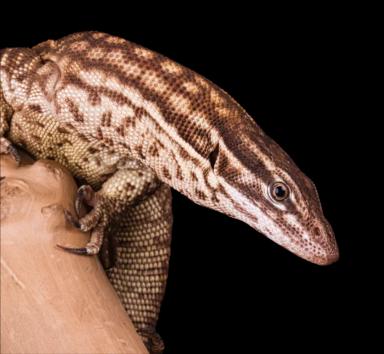
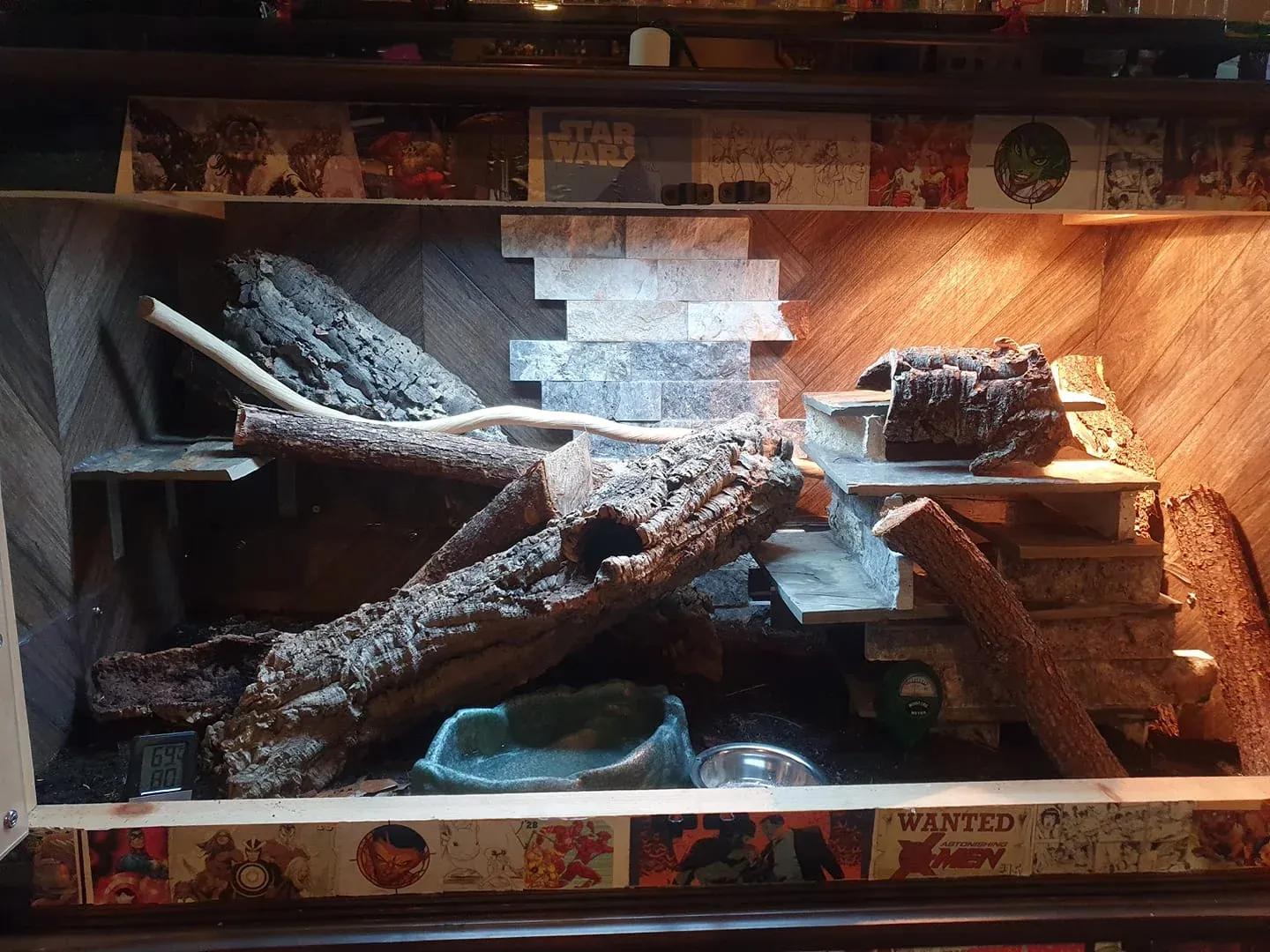
Photo contributed by Rick Croney
In the wild, ackie monitors don’t live in enclosures. Instead, they travel all over the place in their hunt for food and (in the case of males) mates. Although ackies don’t travel quite as much compared to other monitor species, they are still monitor lizards, and therefore very active. The amount of ground that the “relatively inactive” ackie monitor covers on a routine basis is still more than most reptile keepers can perfectly replicate — in Water and Energy Turnover in a Small Monitor Lizard, Varanus acanthurus by Gil Dryden et al., the greatest distance that ackie monitors were observed to move between refuge sites was “only” 71 meters.
There’s no formula for determining the “perfect” ackie monitor enclosure size, but what we can do is look at those who have successfully kept ackies, observe what size those keepers used, and use that data as a starting point for determining what is likely to be an appropriately-sized enclosure for an ackie monitor.
An appropriate minimum ackie monitor enclosure size for housing one adult long-term must meet the following requirements:
Using data from experienced keepers integrated with knowledge of ackie monitors’ natural behaviors, the ReptiFiles minimum size recommendation for an ackie monitor enclosure is 5’L x 2.5’W x 4’H. These dimensions allow 12.5 sq. ft. of floor space, a generous substrate layer, room for climbing materials, and facilitate a sufficiently diverse temperature gradient despite extremely high basking temperatures. Of course, larger is always better!
Enclosures of these dimensions are not readily available for purchase, primarily because 36” wide enclosures are fairly rare, and the enclosure must also include a 24” high substrate barrier. This means you will need to make a custom order. Listed below are reputable reptile enclosure manufacturers which accept custom orders with reasonable fulfillment time:
An ackie monitor enclosure should also have good ventilation (whether via screen top or plentiful vents) to prevent excess heat buildup, and be front-opening to allow for ease of access. As an optional (but highly recommended) feature, request a thick glass substrate barrier so you can view your ackie even when it’s underground.
Of course, buying a custom-made reptile enclosure can be expensive. If ordering a pre-made custom enclosure is out of your budget, you’re reasonably handy, and you have the time, you can build your own instead. Benefits of building your own enclosure include saving money and being able to build according to your ackie monitor’s specific needs. For tips and blueprint ideas on building an ackie monitor enclosure, ReptiFiles recommends joining the DIY Reptile Enclosures group on Facebook.
Professor Herp also has a helpful set of build instructions which can be accessed here.
Yes.
By starting your new ackie in an adult-sized enclosure, you will save money by not having to buy multiple enclosures as it grows.
Yes, but it’s not required for their wellbeing.
If you are new to keeping ackies and don’t have enough room for an enclosure much larger than the abovementioned minimum, then it’s best to only keep one per enclosure. They’re not particularly social, so you don’t have to worry about it getting “lonely”.
If you are more experienced with ackie monitors, then you may consider housing them together for breeding purposes or simply to enjoy how their behaviors change in a social dynamic. However, *this will require a much larger enclosure* and lots of supervision, as there’s no guarantee that the lizards will get along.
Anecdotal reports from experienced keepers indicate that the best combination is likely 1 male and 1 female. Because ackies lay eggs to reproduce, if you have no intention of breeding, you can simply freeze the eggs immediately after they are laid (see more information on dealing with eggs here), and some (such as Frank Retes) argue that keeping a female monitor’s reproductive system active in this way is the best way to prevent reproductive health issues such as egg binding.
Instructions for sexing ackie monitors can be found here.
Note that ackie monitors are known to eat smaller members of their own species (Eidenmuller, 2007), so do not attempt to house larger ackies with those that are significantly younger/smaller.