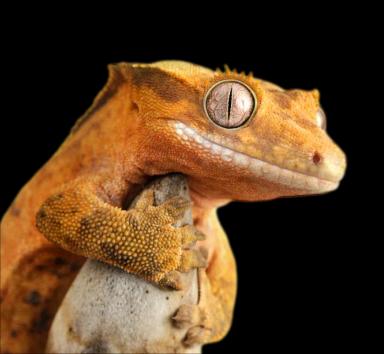
Even though crested geckos are crepuscular/nocturnal, they do benefit from having some kind of light during the day. According to Dr. Frances Baines’ UV Tool, crested geckos (referenced in the paper as Rhacodactylus ciliatus) should receive 14 hours of light per day during the summer and 10 hours of light during winter, 6 months each. This helps regulate their circadian rhythms, seasonal cycling, and improves activity, appetite, and overall health.
Don’t bother with black/blue/red light bulbs for night viewing or supplemental heat. Crested geckos’ eyes function perfectly in the dark, and providing light at night can actually mess with their day/night rhythm. Also, nightly drops in temperature are actually healthier than providing heat at night. My opinion? Save yourself a few bucks and don’t bother.
Many people will tell you that UVB is not necessary for crested geckos in captivity—that they get all the vitamin D3 they need from high quality prepared diets. While it is true that not having access to UVB won’t necessarily kill a crested gecko, there is a growing body of evidence that providing UVB substantially increases health and quality of life for reptiles previously thought not to need it.
Furthermore, UVB bulbs also produce UVA light, which is a spectrum of light that reptiles can see but humans can’t. They see it like an additional color. Imagine if you had to live without the rainbow of colors in the visible light spectrum—seeing only in black and white. Wouldn’t that be dull?
ReptiFiles recommends UVB lighting for all reptiles, including crested geckos. Since cresties are crepuscular and typically hide behind leaves during the day, they are classified under Ferguson Zone 1, which means you don’t need anything particularly strong. If you have a Solarmeter 6.5 (recommended), the UVI at the basking branch should be between 1.0-2.0. If you don’t have a Solarmeter, here’s a fair baseline for distancing with each bulb type:
These estimations assume that the UVB lamp is placed above the terrarium mesh rather than inside the enclosure, assuming a ~35% mesh block. For more details on adjusting basking distance based on mesh obstruction, see the Facebook group Reptile Lighting > Guides > Guide 1: Using T5-HO lamps above a Mesh Screen.
Hatchling crested geckos (under 13g) are often housed in small “grow-out” enclosures to keep track of their health during this vulnerable phase of life. If you have or are planning to get a hatchling crested gecko, there are some special accommodations you will need to make in terms of UVB lighting.
If you put a UVB lamp on top of a hatchling’s tiny grow-out cage, you will likely expose it to dangerously high levels of UV. To keep your hatchling safe while still providing the benefits of UVB light, use a forest-strength compact coil bulb in a 5.5″ dome fixture hung from a reptile lamp stand. Turn off the light at night.
Specific products I recommend for hatchling lighting: