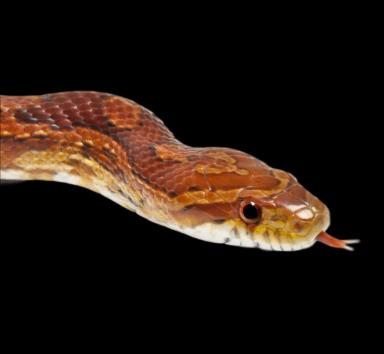
Corn snakes are reptiles, which means that they are ectothermic, or cold-blooded. Ectotherms rely on their environment to provide the heat energy that their bodies need for proper metabolism. Reptiles that do not have access to enough high-quality heat are likely to experience problems like low energy, susceptibility to illness, and slow healing.
Perfect corn snake temperatures occur on a gradient, with the highest temperatures in the basking area and coolest temperatures in the shade on the opposite side of the enclosure. This enables to the snake to move between zones as is comfortable. Here’s the parameters you need to pay the most attention to:
Heating should be turned off at night for most corn snakes, but if you have a hatchling <1 year old, it’s best practice to keep them warm at night. Like most babies, hatchling corn snakes can be delicate. Methods for effectively heating a corn snake’s enclosure at night are discussed in the next section.
To keep track of the temperatures in your corn snake’s home, you will need a couple of digital probe thermometers. Not stick-on thermal tape or an analog dial thermometer — digital!! These thermometers tend to be the most accurate, and as a result will allow you to make sure the enclosure is providing an appropriate environment for your corn snake’s needs. Most brands of digital reptile thermometer are good enough to be used effectively.
Of course, a digital probe thermometer is only as good as its probe placement. To get the results you’re looking for, place the probe of one thermometer on the basking surface (you may need to secure it in place with a dab of superglue or zip tie) to monitor basking temperatures. Then place the other thermometer probe on the substrate in the cool zone.
Getting corn snake temperatures in the right place can take some fiddling around, especially since different heat bulb wattages produce different temperatures depending on a variety of factors, such as enclosure height and room temperature. This is one of the big reasons why it is important to set up your enclosure at least a week before bringing your corn snake home!
Heat is a type of energy called infrared. Infrared is invisible to humans and most reptiles (certain snakes being the exception). Just like there’s different types of ultraviolet light, there are also different types of infrared: IR-A, IR-B, and IR-C.
The goal of providing heat in a reptile’s enclosure is to imitate the forms of heat it would experience in the wild as accurately as possible. For more information, I recommend reading Next Level Heating: Why Infrared Wavelengths Matter by Roman Muryn.
In nature, warmth comes from the sun (above), not from the ground (below). In fact, reptiles retreat underground to escape the sun and get cooler, not warmer. Providing warmth from below, as with a heat mat, is therefore unnatural and will promote unnatural behaviors. Heat lamps solve this problem by mimicking the effects of the sun and warming both the air and the ground below.
Of course, there are several different types of heat lamps:
Considering that the goal is to replicate sunlight as the primary source of heat in a corn snake’s environment, we recommend using halogen flood heat bulbs as the most effective method of providing heat to your corn snake. There are many different types of heat bulbs on the market, from reptile-specific brands to ordinary bulbs at your local home improvement store. Reptile brand halogen bulbs can work well, but they tend to be short-lived. Personally, I’ve had the best experience with the 90w Halogen PAR38 Flood bulb.
For best results, get 2 bulbs and mount them in a Zoo Med Mini Combo Deep Dome fixture or two 5.5″ dome lamps. For safety reasons, the bulb socket must be ceramic, not plastic. I also recommend getting a couple of plug-in lamp dimmers like the Lutron Credenza so you can dim the bulbs if they get too hot. Alternatively, you can invest in a proportional (dimming) thermostat like the Herpstat 2 which will do that for you automatically.
Place the heat lamps above the basking surface, which should be the same thick branch that will be placed under the UVB lamp. I recommend using two heat bulbs instead of just one because this facilitates more even heating over your snake’s body, which is better for its circulation and overall health. Using one bulb won’t be a problem when your snake is just a juvenile, but as it grows, this becomes an issue.
If you are concerned about “belly heat,” here’s some good news: the branch will naturally absorb warmth from the heat lamp, warming the snake from below when it sits on it.
WARNING: Heat lamps should be mounted on top of your corn snake’s enclosure, not inside. Even when surrounded by a bulb cage, young corn snakes may be capable of worming their way inside the bulb cage, causing severe burns or even death!
As a lightless source of Infrared-B and -C (with a little bit of -A), heat projectors like the Zoo Med Infrared Heat Projector or Arcadia Deep Heat Projector aren’t great as a primary source of basking heat, but they are good for boosting your enclosure’s air temps without decreasing humidity too much. Heat projectors are a newer technology that are like an upgraded version of a ceramic heat emitter (CHE), but without the tendency to waste heat or reduce humidity as drastically.
To effectively use a heat projector in your corn snake enclosure, start with the lowest wattage available. Mount it in a ceramic-socket dome lamp and place it in the middle to cool end of the enclosure. To prevent it from getting too hot, you must plug it into a lamp dimmer or proportional thermostat. If using a lamp dimmer, you will need at least a few days of testing different settings on the dimmer to achieve 75°F/24°C in the cool zone. If using a proportional thermostat, program it to maintain the same temperature, with the probe placed in the cool zone.
My preferred lamp dimmers are the Lutron Credenza and the Vivarium Electronics Rheostat. My preferred proportional thermostat is the Herpstat 1.
NOTE: Non-proportional (on/off) thermostats may be less expensive, but they are not suitable for use with heat projectors or light-producing heat bulbs, and are likely to reduce the lamp’s lifespan if used.
WARNING: Heat projectors should be mounted on top of your corn snake’s enclosure, not inside. Even when surrounded by a bulb cage, young corn snakes may be capable of worming their way inside the bulb cage, causing severe burns or even death!
Heat mats are the still the most widely used method of heating corn snakes. Although they have been proven to be effective at keeping the snakes alive and reproducing, they’re not optimal. Heat mats produce only IR-C, the weakest form of heat, which results in inefficient basking. The snakes have to lay on the mats for long periods of time to gather the heat energy that they need. Plus, they do little to heat the air inside the enclosure. For these reasons, I don’t recommend using a heat mat as your snake’s primary source of heat.
However, heat mats can make a good secondary source of heat. When connected to a thermostat for safety and programmed to basking temperature, they can be used to create a lovely warm hideout for your snake, comparable to a sun-warmed burrow in the wild.
To do this, choose a high-quality heat mat roughly the same size as your snake’s warm hide. Trusted heat mat brands include Fluker’s and Ultratherm. Place the mat under the hide, covered by about 2″ of substrate. Then plug the mat into a thermostat and place the thermostat probe inside of the hide, on top of the substrate. Check the probe placement regularly.
Heat mats can only be safely used if paired with a thermostat, a device which regulates how hot the mat gets. Even if the heat mat claims to not need a thermostat because it only gets to a certain advertised temperature, believe me — it still needs a thermostat. Many a snake has been cooked to death by heat mat malfunctions!
Thermostats range in quality and price (lower price usually means lower quality). Herpstat is the best and most reliable, but if you’re on a tight budget, Inkbird and the Exo Terra Thermostat are low-cost options. Make sure to buy a thermostat appropriately rated for your heat mat’s wattage.
Heat rocks (also known as hot rocks/rock heaters/etc.) are manufactured and distributed under the same premise as an electric blanket — convenient heat whenever your reptile needs it. Sounds like a great idea, right? However, heat rocks are notoriously unreliable, and many a reptile has lost its life due to severe burns caused by these devices. Additionally, they’re not a good choice for heating your enclosure, as it only warms the rock’s surface, not the surrounding air.