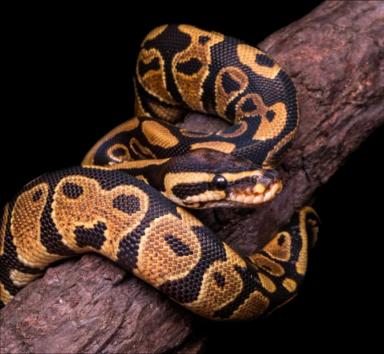
Because ball pythons are reptiles, they are cold-blooded, and that means they rely on their environment for the heat needed to regulate their metabolism. If the temperatures or humidity is off, the snake may stop eating.
Python regius is native to Africa’s tropical savanna climate zone, and according to climate data from TimeandDate.com, the average temperatures in this area between 68-86°F (20-30°C) over the course of the year, with occasional spikes up to 96°F (35°C) or higher. However, keep in mind that ball pythons spend a significant portion of their lives in burrows, where temperatures are cooler and more stable than the open air above.
General air temperatures in a ball python’s enclosure should never exceed 95°F (35°C)!
If your home gets cooler than 70°F / 21°C at night, you will need a lightless heat source to warm up the air. Options for nighttime heat include ceramic heat emitters, radiant heat panels, and deep heat projector. While these devices can be handy for also assisting comfortable ambient temperatures in your ball python’s enclosure, they should not be used for daytime “basking” heat, as they produce weaker spectrums of infrared radiation (heat). More on that later.
To measure the temperatures inside your ball python’s enclosure, use an industrial-grade temp gun, a.k.a. infrared thermometer, such as the Etekcity 774. These temp guns have better range and accuracy than the ones sold in pet stores. This point-and-shoot tool is suitable for measuring temperature all over the enclosure, including inside hides.
However, if you want more continuous temperature monitoring, you will need at least two digital probe thermometers, with the probes placed where you want to be checking temperatures. Most pet-brand digital probe thermometers work well enough.
Since ball pythons are terrestrial, night-active reptiles, the most important part of the enclosure to be paying attention to for heat is going to be the “warm hide“. As the name suggests, the warm hide is a hide box, cave, or burrow located on the warm side of the enclosure, directly underneath the basking lamp(s). Although your ball python will likely spend most of its time in cooler areas of the enclosure, the warm hide is an essential resource when the snake needs to ramp up its metabolism (i.e. digestion, fighting illness, etc.). The top of the warm hide can also make a great basking surface for when your pet is in the mood for more intense heating. The best way to simultaneously create a basking spot (“sunbeam”) and warm hide is with a cluster of heat lamps.
Heat lamps are a controversial heat source for ball pythons, but in nature, heat comes from above (the sun), not below (ground). While heating mats and heat tape are the most commonly used heat sources for ball pythons, they are unnatural and promote unnatural behaviors. Furthermore, they’re highly ineffective at warming the air inside of adequately-sized enclosures. Heat lamps warm both the ground and air inside of an enclosure, making them the more appropriate tool for heating terrariums.
Incandescent heating provides the largest quantity of the highest-quality form of heating for reptiles: Infrared A radiation! These wavelengths penetrate deeply into animal tissues, heating them up faster and helping them stay warm longer, which means less time “wasted” on basking, a stronger immune system, and more energy for digesting, exploring, etc. For a more detailed explanation of the significance of the different types of infrared (heat) in reptile care, read Roman Muryn’s publication: Next Level Heating: Why Infared Wavelengths Matter.
Be sure to buy white or clear bulbs rather than red, blue, black, or whatever other color you’ve found, as these unnaturally tint your snake’s environment — and ball pythons CAN see color!
Not to be confused with a red-tinted bulb that is being advertised as an “infrared” lamp when it is, in fact, just a red heat lamp, the Reptile Systems Infrared Heat Unit has the best Infrared-A output available on the current market. If you can afford it, it’s well worth the investment (plus, they last for a long time)!
If you’re wondering which wattage to get, helpful charts estimating temperatures by distance are available here.
Handle these bulbs with gloves on to help preserve the bulb’s lifespan by keeping your skin oils off the glass.
Best incandescent and halogen bulbs for reptiles: Arcadia Halogen Heat Lamp, Vinaco Halogen Flood bulbs (Amazon), Exo Terra Intense Basking Spot
If your ball python’s enclosure is more than 36″ long (which it should be), you will need a cluster of at least two halogen bulbs placed close together to create a basking area large enough to evenly heat most of your snake’s body when in a coiled position.
When using a screen-top enclosure: If you are using a glass terrarium or other enclosure with a mesh top (ex: Zen Habitats, Dubia.com), the easiest way to do this is to use a dome-style heat lamp fixture with a ceramic socket, like the Zoo Med Combo Deep Dome dual lamp fixture. That way the mesh will create a barrier between the bulb and the snake, preventing burns. Plus, using two bulbs rather than one creates a larger basking area that will be better able to evenly heat your ball python’s body.
If you have to install heating inside your enclosure: It’s not ideal to install heat lamps inside a snake enclosure, as it reduces the amount of available vertical space available to your pet, and snakes are more likely than other reptiles to come into contact with the heating equipment. If the heat bulbs must be installed inside the enclosure, you will need bulb cages like the Arcadia Heat Lamp Cage to keep your pet from getting burned!
This is a common question with no solid answer, sorry! What wattage bulb you will need depends on room temperature, enclosure height, and other factors. What works for one person won’t always work for another, which is why I like dimmable heat lamps so much. When in doubt, try the higher-wattage bulb first and dim as needed.
If your room temperature tends to fluctuate by season, consider purchasing a proportional thermostat like the Herpstat 1, which is the top performing proportional stat in the US at its price point. Unlike non-proportional thermostats, which switch a heat source on and off in order to maintain the target temperature (this can be very annoying when you’re using a light-based heat source), proportional thermostats simply dim the heat source instead.
For best results, place a thin, flat, light-colored rock (flagstone or similar) directly under the heat lamp, along with the warm hide. This is the perfect way to create an ideal basking surface. It also helps transfer heat to the warm hide, which should be placed directly under the basking rock (I find that black plastic hide boxes work GREAT for this). If your warm hide still isn’t getting warm enough, you will need help from a thermostat-controlled heat mat.
Many snake keepers use a heat mat as their primary heat source of choice, covering about 1/3 of the terrarium’s floor space. However, this popular practice only worked when the snakes were kept in plastic tubs and otherwise undersized enclosures, as heat mats lack the power to create warm enough ambient temperatures in appropriate-sized enclosures with a deep substrate layer — in fact, trying to use a heat mat exclusively in an otherwise “cold” enclosure is a good way to give your snake a serious burn! Furthermore, they only produce Infrared-C radiant heat rather than the stronger, deeper-penetrating IR-A and IR-B of halogen bulbs, which compounds their inefficiency as a primary heat source.
So why are heat mats listed as a “good” heat source for ball pythons? Because they’re actually rather good for helping maintain your snake’s warm hide! More or less any well-rated heat mat will work, but mats designed for seed germination have also been used successfully (and are particularly good because they’re waterproof and not sticky).
However, a heat mat is only as good as it’s been set up properly, so here are some rules for using a heat mat in your setup to keep your ball python safe and healthy:
1. Use a heat mat only as a secondary heat source, never a primary. This means that you should be relying on heat lamps first, then adding a heat mat only if you’re having trouble hitting the right temperatures in your warm hide.
2. Don’t let the snake come into direct contact with the mat. Instead, either bury the mat 1″ below the substrate under the warm hide, or (this is my preferred method) place the mat on top of a black box hide and then place a piece of flagstone on top of that. The flagstone then acts as the basking surface as well!
3. Connect your heat mat to a good thermostat! Heat pads have a nasty reputation for overheating, so make sure to buy a thermostat along with it so you don’t accidentally burn your snake. Most people prefer the relatively low cost of non-proportional thermostats for use with heat pads, such as Inkbird. For something higher quality and much less likely to fail (read: safer), consider the Herpstat 1.
I made the mistake of using a heat pad sans thermostat once, and it not only warped the plastic tub, but also changed the color of the wood beneath. The snake was, fortunately, safe, but I had unwittingly kept a major fire hazard in my reptile room during those months.
4. Place your thermostat probe on the snake’s level. Some will tell you to put the thermostat probe on the heat mat itself — this does not enable the thermostat to control the temps that the animal feels, only how hot the heat mat itself gets. In other words, it renders the thermostat almost entirely ineffective. Instead, place the thermostat’s probe inside your ball python’s warm hide, resting on top of the substrate. By placing the probe on your snake’s level, you will know and be able to control exactly what temperature s/he is experiencing. Make sure to check the probe’s position daily and replace it if needed.
For best results, program your thermostat or digital outlet timer to maintain the warm hide’s temperature via heat mat all day and about 2 hours after “sunset” before turning off. This helps replicate the way the sun would warm a burrow in nature.
Like a heat lamp, but weaker. These are generally preferred by large snake keepers or keepers with particularly large enclosures because radiant heat panels excel at creating large areas of warmth. Because they’re installed on top of the enclosure, burn/fire risk is lessened compared to heat mats or heat tape. Heat panels must be regulated by a proportional (dimming) thermostat to be used safely.
Heat panels can be purchased at Bean Farm.
DO NOT USE HEAT ROCKS!
For some unfathomable reason, heat rocks are still on the market, recommended by pet stores as a “safe” source of heat for your snake. Though safety improvements have been made in recent years, they are still dangerous. Furthermore, they’re not a good choice for heating your enclosure, as it only warms the rock, not the surrounding air.