Product Review: Evergreen Reptile Fogger
October 5, 2018
This article contains affiliate links. ReptiFiles was not paid or compensated in any way to provide this review. For more information, read our Affiliate Disclosure.
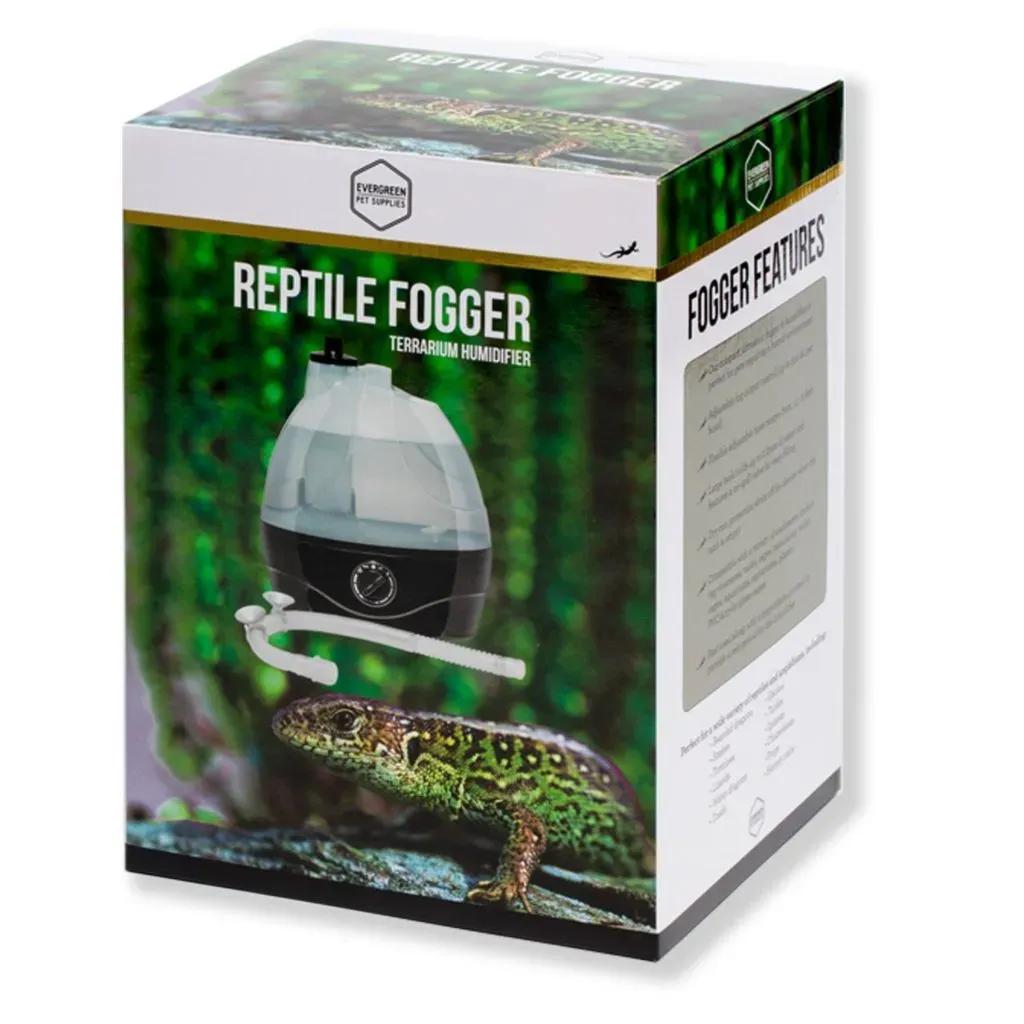
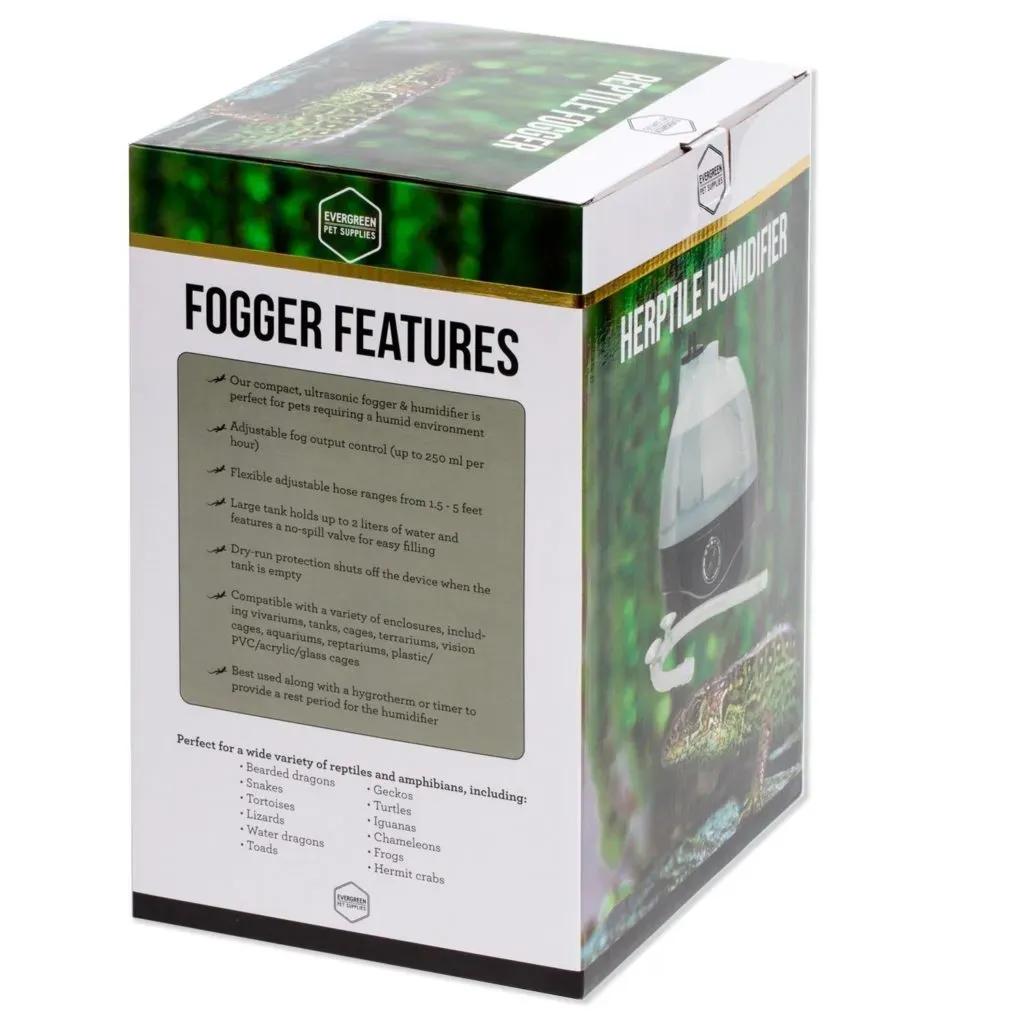
Reptile foggers (also known as humidifiers or vaporizers) are devices which produce a fog of microscopic water droplets in order to raise ambient humidity in a reptile enclosure. Foggers are especially helpful for raising humidity in screen enclosures with limited drainage, as these tend to struggle most in maintaining consistently high humidity while also maintaining high ventilation.
The Evergreen Reptile Fogger is listed in many “best reptile fogger” articles as a top performer, and holds a rating of 4/5 stars on Amazon, with over 600 reviews. Since so many people were raving about it and I was looking for a lower-maintenance way to boost my Merauke blue tongue skink’s humidity levels, I decided to give it a try.
Product Specs
- $59.99 with free Prime shipping on Amazon
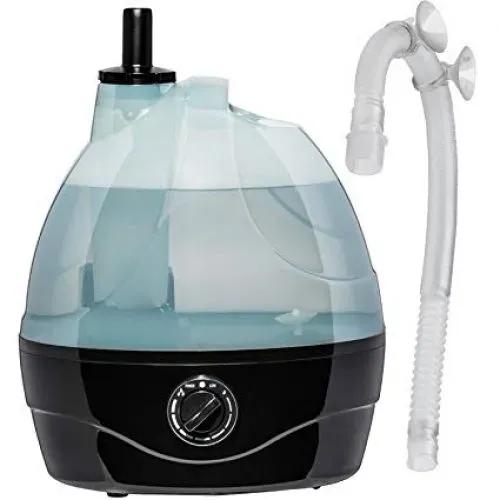
- Comes with: humidifier unit, half gallon tank, extendable tube, suction cups
- Hose measures 1.5′ when compressed to 5′ at full extension
- Features an adjustable dial to determine output
- Max output: 300 ml/hour
- No filter required
- Has a green light that turns red when the tank is empty
- Automatically shuts off when empty to prevent damage to the unit
- “Offers a longer lifespan than the average of other comparable humidifiers”
- 6 month warranty
Functionality Assessment
Assembling the fogger was very easy and intuitive — it only took a few minutes and I probably could have figured it out even without the instruction booklet.
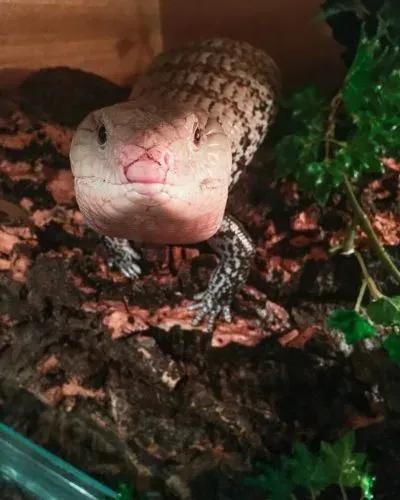
I decided to test out the Evergreen Reptile Fogger in Hermes’ enclosure. Hermes is a Merauke Indonesian blue tongue skink, and at the time of this review he is housed in a homemade wood enclosure with a mesh lid mostly covered with aluminum foil to help trap humidity. In the past this enclosure has struggled to maintain the 60-80% humidity which T. gigas evanescens requires for best health.
The hose was difficult to position in a non-glass enclosure, rendering the suction cups useless (they were a pain to position anyway). Ideally I wanted to be able to place the hose on top of the mesh so the fog could pour into that part of the enclosure from above, but I couldn’t figure out a good way to make the hose stay in that position. Instead, I lifted the lid of the enclosure to pin the hose underneath, and made sure that my escape-prone and disproportionately strong skink couldn’t exploit the gap by sticking a thick piece of spare flagstone on top to weigh it down. Not pretty or convenient, but at least it was positioned inside the enclosure.
(In retrospect I probably could have rigged something for the top involving a funnel, duct tape, a drill, and some zip ties, but I’m not very crafty so I’m not sure how well that would have worked.)
The dial on the front governs fog output from a trickle to full blast, which is nice for achieving the desired effect, whether filling the enclosure with fog or just keeping one region of the enclosure humidified.
Like all humidifiers, the Evergreen Reptile Fogger must be used with distilled or RO (reverse osmosis) water to prevent mineral buildup from ruining the machinery. Filling the tank was not easy, as the instructions simply pointed to a valve on the bottom of the tank and indicated that is where you fill it. I thought this meant that I had to depress the valve in order to pour water inside. The result was a very slow filling process that involved a lot of wasted 99¢ water on the floor. I didn’t realize that the valve piece came off, so I was ready to drill a hole in the top for easier filling until I started doing research for this article and found a Youtube video by Impresa Products on how to fill this particular fogger. Later I found out that my husband had been doing it the right way all along. Boy, did I feel stupid. But I’m not the only one with this issue — lots of reviewers on Amazon experienced the same misunderstanding.
Another issue I encountered with the hose is that if it sags at all, condensation will collect on the folded inside of the tube and eventually create a puddle of water that blocks the fog until you adjust the hose and pour out the pooled water. The connection between the hose and humidifier unit is also fairly weak; in my experience it popped off easily and if it wasn’t secured tightly, fog would leak out around the connection, especially when the hose got blocked.
Once it was working correctly, it did a very good job of raising the ambient humidity inside the enclosure. Hermes appeared to like the the fog and would sit directly in the stream for extended periods of time. However after a couple weeks of use he did develop a minor infection in his right eye. We were able to resolve the issue after we stopped using the unit and went back to simply mixing water into his substrate for humidity, as well as administering Zoo Med Repti Turtle Eye Drops. We are not sure if the occurrence was coincidence or related.
Things I Liked About the Evergreen Reptile Fogger
- Efficient; can go for a while even on full blast with a full tank
- Super quiet
- The output range permitted by the dial is super handy
- Hermes seemed to like it
- Sleek design; more or less attractive
- Product description recommends: “Always consult an expert regarding your particular species before using a humidifier.”
Things I Didn't Like About the Evergreen Reptile Fogger
- Expensive — for such a simple device I would value it at about $40, not $60. For that price I expect some kind of automation feature. I can get a comparable human humidifer (although hoseless) from my local grocery store for $25-$35.
- The instructions did not explain specifically how to fill the tank, which is an oversight that creates a lot of unnecessary customer frustration.
- Filling from the bottom is still not very easy — it would be better to fill from the top because then users can set the unit down while filling, helping reduce the risk of spilling.
- Hose has a loose connection to the humidifier, pops off easily
- Suction cups are more hindrance than help
- The lack of a timer on the unit encourages near constant use, which promotes damp conditions that encourages bacterial and fungal growth, which can compromise reptile health in turn.
- Blue tongue skink developed an eye infection shortly after we began to use the unit
This product is advertised as perfect for “reptiles and amphibians of all kinds, including bearded dragons, geckos, snakes (ball python, rainbow boa, red tail boa, reticulated python, green tree python, etc.), turtles, tortoises (Russian, red footed, etc.), iguanas, lizards, chameleons, water dragons…” I understand that Evergreen Reptile Systems is trying to cast their net as wide as possible, but advertising to bearded dragons specifically worries me because it demonstrates a distinct lack of either regard or understanding pertaining to correct reptile husbandry. Bearded dragons are an arid species that require very little in the way of humidity, and the use of a device such as this in a bearded dragon enclosure would likely lead to respiratory infection.
Conclusion: Eh, it does the job.
ReptiFiles Rating: 3 stars
The Evergreen Reptile Fogger is not a better alternative to an automated misting system, but it’s quiet, does a good job of raising ambient humidity, and is easy to control. Despite its idiosyncrasies and expensive price tag, I would recommend it for anyone looking for a product that will raise ambient humidity without drenching the substrate, and overall it’s probably better than other reptile foggers currently on the market.
This product is suitable for reptile species requiring constant humidity of 60% or higher, such as:
- Blue tongue skink (Tiliqua gigas ssp. & T. spp. “Irian Jaya”)
- Crested gecko
- Gargoyle gecko
- Jackson’s chameleon
- Leaf-tailed gecko
- Mourning gecko
- Tegu
It may also be used in place of misting for species which need a daily humidity boost (ex: ball pythons, boas).
Advice for the manufacturer:
- Revise the product instructions to describe exactly how people should fill the humidifier.
- Add a timer so people don’t have to risk bacterial/fungal growth in their enclosures due to constant fogging.
- Since it is common for reptile enclosures to have a mesh lid, add a piece that will make mounting the hose on top of a mesh lid easier.
Advice for reptile keepers:
- Watch the video on how to assemble and fill your Evergreen Reptile Fogger.
- Use distilled or reverse osmosis water only.
- Clean the tank and base unit once a week with a disinfectant solution like F10SC or chlorhexidine — this is VERY IMPORTANT for preventing illness from developing in your reptile.
- Use with a timer to allow the enclosure to dry out between periods of fogging. Constant fogging is not healthy for most reptiles, and the excessive moisture buildup helps germs grow.
- Only use the fogger at night, preferably for a few hours following “sunset” and an hour or two prior to “sunrise”. Using the fogger during the day can cause ambient temperatures to become dangerously high.
- If you’re at all handy, you’ll save money and get a potentially more functional product by buying a human evaporative humidifier and attaching your own hose, as demonstrated by this Youtube video.
- If you can afford it, get an automated misting system instead.
The Evergreen Reptile Fogger can be purchased from Amazon here.
Are you a reptile product manufacturer with an awesome new product that you want the world to know about?
Contact us at [email protected] to learn how YOU can get featured on ReptiFiles.
Comments
Authenticated users can leave comments on this post. All new comments are given the status "draft" until they are approved by an admin. Draft comments are not accessible to the public and will not show up on this page until it is marked as "published". To manage all comments, navigate to the admin dashboard.